


 Spotify

 Apple Podcasts

 Amazon Music

 YouTube

 iHeartRadio

 Goodpods

 RSS Feed

 Castro

 Castbox

 PocketCasts

 Podchaser

 Pandora
Kitchen Table Issues and The Affordability Crisis
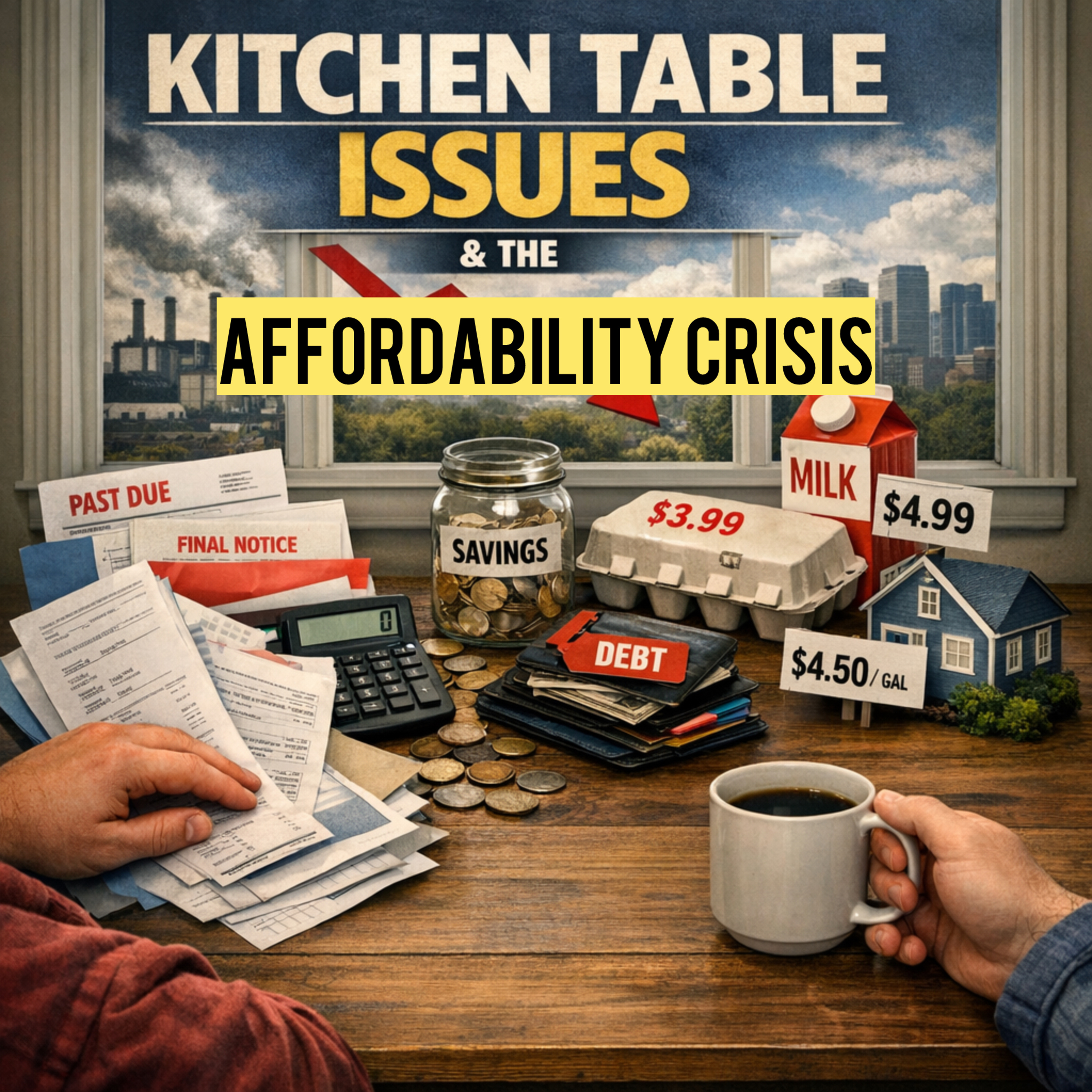
Ayana gets personal while exploring the real meaning of affordability in America, highlighting how political rhetoric often misses the lived experiences of everyday families. She emphasizes the importance of tangible solutions over slogans in addressing the ongoing crisis of rising costs and economic inequality.
Join the conversation by leaving a comment for the show on our social media pages!
Ayana Fakhir (00:01)
Affordability isn't branding. It's a lived experience. It's the quiet math millions of Americans do every single day. It's standing in the grocery aisle deciding what goes back on the shelf. It's looking at the gas gauge and wondering if you can stretch it another two days. It's staring at a medical bill, a rent payment,
a child care invoice
and realizing the numbers just don't all fit. But if you listen to today's political campaigns, you'd think affordability was a marketing strategy, a talking point, a word you sprinkle into a speech because polling says voters care about it. And we do. In 2026, it's called an affordability crisis. And politicians...
or people running for office are campaigning on these so-called kitchen table issues. The ones that Americans talk about when they get home from work, when they're sitting at their kitchen table with bills scattered around them, or maybe they don't even have a table. Maybe they don't even have a place to live. But these are the issues that Americans are faced with every single day.
But here's the problem. We don't experience affordability in speeches. We experience it in our bank accounts.
It's time we talk honestly about what affordability actually means in the United States of America right now. Not the slogan, not the spin, but the real kitchen table economics shaping how people vote, how we live, and how we survive.
I've got some explaining to do. Let's get into it.
Hey
everybody, welcome back for another episode of Ayana Explains It All, the podcast bridging the gap between current events and human behavior. I am your host, Ayana R. Vakir, your black Muslim lady lawyer who has an opinion on everything. And if you know me or if you've ever talked to me while buying plants at the Home Depot, you know that to be true. Ayana Explains It All.
is streaming on multiple platforms, multiple. And I am coming to you from my home in Northeast Ohio. I'm recording this on Monday, March 9th. It's still Monday. It's very late, but it's still Monday. Ayana Explains It All is available On iHeartRadio, Apple Podcasts. We're available on Amazon Music, Good Pods. We're available on Pandora.
We are available on multiple streaming platforms, including our flagship Spotify. Yay. We also have a YouTube channel that is Ayana Explains It All, A-Y-A-N-A, Explains It All. But most of all, we have a website, a website, yes, a website. www.ayanaexplainsitall.com is where you can find everything you want to know, need to know, should know about the podcast, including every...
Episode of the program every episode every everyone from the very beginning from the rough the rough beginnings of this podcast Whoo, and they were rough ladies and gentlemen But you can find ways to support the podcast you can read all of the transcripts show notes
ways to communicate with me, email. can email me, email me at ayanaexplainsitall @ gmail.com. You can also hit me up in my personal email. You might go to spam. I have no control over that, but I am ayanafakhir A-Y-A-N-A-F-A-K, that's F as in Frank, as I always say, A-K-H-I-R at gmail.com. And let me know if you want to collaborate.
You have some suggestions for the show. You have some leads. You want to sponsor me? would love to be sponsored, honey. Sponsored. Sponsor me. Also, you can hit me up on social media. The show is on all of the social medias, including X. But we are on Facebook. We are on Instagram, threads, TikTok. Yes, go visit my TikTok. I got a lovely setup over there.
You can also find me personally on all of the social medias. I'm Ayanna Fakir everywhere. I'm the only Ayanna Fakir, I believe, in existence on the planet, on planet Earth. And that is an honor, honey. That is an honor. So if someone says they know Ayanna Fakir, then they know me. Because ain't nobody else. Me. Ain't no other ones. Ain't no other girl. Anyway.
I love you guys for being here. I know I have some regular listeners, including one of my siblings, one of my sisters, Halima. Shout out to you, Halima. Hey, girl, hey. Halima is in Florida enjoying the beach, probably, because they have beach weather.
listen, y'all, I did something really exciting and I can't even believe I did it. It must be because it's Ramadan. I was in the giving.
giving, cleaning out, reformation, spirit. I cleaned out one of the closets in my home. I have this closet, this deep closet in my office. My office used to be a bedroom, and now it's my office. And it's where I work from home, et cetera. It's where I work from home. It has this nice, deep closet in it. Listen, if I... Listen.
Love the thing about these old houses. They have these nice deep closets. And this one just happened to store all of my arts and crafts. I used to be, and I still kind of am, but now I've moved on to another hobby. That's just the thing about us neurodivergence. We are hobby hoppers, okay? We're on to the next, on to the next, on to the next. And I was really deep into my arts and crafts era. And I...
just one day was like, I want to do something else. I want to do a podcast. And so I kind of shifted my focus from arts and crafts and upcycling furniture and building these miniature doll houses, which I still kept all of them anyway. But so I had, put everything in bins. I put everything in those big plastic bins and I put it in this closet, this deep closet in my office.
It didn't look at it for a couple of years, that stuff would stalk me. Like it felt so heavy. one day, a couple of weeks ago, I said, it's Ramadan. I'm giving all of that stuff away because I am never, and I do mean never, ever going to touch it again. Once I decide I'm done with something, I am done, D-O-N-E forever. I'm still really good at it, but I'm moving on.
Okay, so I took everything out of the closet and there was a lot, a lot of stuff. And me being who I am, I have to do this immediately or I'm never going to do it. Once that fever hits me, once that deep cleaning, gotta get everything out, fever hits me, I have to do it right away. It doesn't matter what time of day it is, what week it is. It doesn't matter that I'm fasting. I was fasting when I did this.
I was fasting and I was sweating and I'm like, I cannot believe I'm doing this. I must be out of my mind. And so I took all of the bins out. It had to have been, not only did I take the bins out, but I was like stuffing things, more things into the bins and I was putting things into trash and I was hauling trash out. But there had to have been at least, I want to say nine bins, small ones, big ones, full.
full to the top that I had to squeeze the lid onto them. And I cleaned it all out, cleaned it all out. And it sat in the hallway for a week until I finally got that fever again. like, okay, I got to take this to the Goodwill, donate all this stuff to the Goodwill. And so I hauled all of that stuff downstairs, put it into my car and I drove it to the Goodwill. First, I had to stop and get some plants. I'm obsessed with how it's plants help.
And then I went and I donated it all. It felt so good. It felt so good, not because I was getting rid of things, but because I knew somebody else could really use this stuff. Like this wasn't cheap stuff either. Good premium papers, wrapping paper, dolls, doll clothes, doll accessories, beads, string, stickers.
all kinds of stuff, all kinds, and the bins themselves. Listen, them plastic bins are not cheap, okay? They're not. And so I spawned law. I just let go of something that even though I probably could have saved it and kept it for myself and used it over the years, it felt better to give it to somebody who could use it right now.
So I got the closet cleaned and the reason I did that was so I could turn this closet, this deep closet into like a recording studio. Yeah, why not? Why not? I'm gonna post a video on my socials of what it looks like,
It's deep enough, it's big enough that I can fit all of my podcasting material, like everything, I can fit all of my podcasting materials in here. I can fit, I have a stand for my tablet or my laptop. It comes with an attachment for my phone. I have a fan in here. I have a little clip-on light and I got some of those wall sound dampeners.
those black things that you put all over, what do you call those things? Sound, dam, whatever you call them. And I put them all over the walls and on the door. It's an enclosed space, which is much better for recording. It's nice. I love it. I can't believe it took me so long to think of this.
It's so cozy. I love it. It makes me feel like I'm a real professional. So yeah, that's what I've been doing. Also, I've been fasting because it's Ramadan. Also, I've been working. I told you guys I've been working with our vote counts, the group who are just getting out the word about these midterms and voting. We are focused on voter education, getting people to the polls.
Helping
people understand who is running for office, what the different functions of these offices are, and what these politicians can do for them, for you, for me, for us, the voter. And that's something I'm gonna talk about in this podcast episode too, what politicians can do to make our lives better, our day-to-day lives better. People think that at various levels, the federal level, they can't do anything, that's the state's responsibility. And then the state is like, my hands are tied.
And then at the local level, they're looking around, well, we're waiting for guidance from the state. So I'm going to talk about that. But our vote counts. We do town halls on TikTok Live. Town halls featuring different political candidates from all around the country. Listen, and I do mean all. The other day, we had our first candidate from Oklahoma. dazzling. These people are amazing. They're talented.
We had from the Texas primaries and the North Carolina and Arkansas primaries, we had several candidates that we featured on our town halls won their primaries. So we're, mean, I feel like we're giving these people a greater voice. We're amplifying their voice, getting their faces out there, getting their voices heard. A lot of these candidates, people don't know who they are and they don't have big money behind them. They don't.
They don't. They're grassroots. A lot of them are truly grassroots. They rely strictly on no money from donors whatsoever or just the public giving them, you know, fundraising, fundraising from the public. Five hundred dollars here, two dollars here, three dollars here, twenty dollars from the grandma. I mean, it's it's been wonderful and seeing people actually win their primaries. I would love to see people go on to win the whole thing. The general election in November third.
So that's what I've been doing. I've been doing a lot of these town halls, man, a lot. Lord. I feel like a mule, a mule. Is it a mule, a pack mule, a horse, a teamster, a roadster? No, whatever. Anyway, that's what I've been doing. So podcasting, I've been slowly putting together an idea about what I wanted to talk about. And this is something, this affordability crisis, these kitchen table issues is something that...
nearly
every single candidate we have talked to has mentioned this or I've asked them about it and I wanted them to talk about it because it's hitting us really bad in 2026. Real, real tough, right? We're seeing the gas prices go up. We're seeing the cost of goods go up and being told, it's for the greater good, just a little bit of pain and the payoff will be wonderful. Just a little bit of pain for the greater good. And listen,
I don't want to experience any pain, but if I'm going to experience pain, I don't want it to be in my bank account. I would love to be able to pay for gasoline and food and shoes, maybe. I'd like a pair of shoes. I knew he'd jab. Some of my jabs have holes. Like, ooh. You know, the millionaires and the billionaires don't have to feel the pinch and the pain. Why are you all continuing? You all.
When I say you all, mean the government, the government continuing to squeeze the middle class and then make poor people even more poor, poorer rather. And then telling us to just, just take it, just take it, just take it, just take it, just take it. Like it's a, anyway, I'll move on. So.
That's what I'm talking about today, you know, and it's funny because I don't know if you all know this, but...
The very, the wealthiest Americans, the richest Americans, the richest citizens of the United States are not just rich, but they own more of the country's wealth than the bottom 60 % of Americans.
The richest Americans own more wealth than the entire working class. And they pay a lower tax rate than any other income
They own all of the money.
and they pay the lowest tax rate.
when we say kitchen table issues, we are exclusively talking about the working class, the nine to five-ers. This is who the midterm politicians running for office aim to target with their platforms, who they swear to help in their new or continuing elected roles. Let me start at my own kitchen table, right? I've talked about my children.
I
have two children, a 21-year-old son who's a senior in college, and for four years I've been trying to keep him enrolled without drowning in debt. I have not been successful. And now my daughter, who was 18, who was 18 and a senior in high school, is about to graduate. And instead of feeling in that celebratory mood like some parents are,
I'm staring at these numbers. I'm looking at these college acceptance letters.
and I'm looking at the numbers they've given us for tuition, room and board, looking at these numbers and I'm wondering how in the hell I'm supposed to do this again. Alone, mind you. No help. No help from another parent. Yeah, I do this all alone, by myself. On the salary of a public service attorney.
Don't ask me how. If you ask me how, if you do, the answer is prayer, honestly. Prayer. I'm a big believer in the power of prayer. Big believer. I'm also a big believer in the power of work. And I work a lot. I work a lot. I work so much I hardly ever take a vacation. Can't afford to anyway. But I work.
six days a week. And I parent and I do these town halls and I might get an hour to watch something on TV during the week, maybe. Yeah, that's my life. And I'm trying to figure out where my daughter's gonna go to college and I have no idea because all of these colleges, they cost so much money. And I'm not talking about like,
$40,000, $50,000. No, a lot of these private schools, even the smaller ones, they start at $80,000? $80,000. $80,000. $80,000. Some go as high as $150,000 a year. $150,000 a year for a college education.
When I went to college back in 1996, it 25,000, between 25 and 30,000. And that was a lot.
but I was able to finance my entire four years.
with very little help from my parents. My mother gave me money for books. alhamdulillah. That was what she could afford because she had four kids. and she had a kid who was already in college and she had her own student loans that she was still paying back from when she went to college in the 1970s.
The United States of America has never not been the place where the cost of higher education literally takes you in your entire life to pay back.
You're either going to be paying it off for the rest of your life, or you're going to be working two in three jobs nowadays because the economic payout when you graduate is not there, like maybe it was 20 years ago, 30 years ago. You're going to be living with your parents maybe, which is, in my book it's fine. Live with your parents, save some money, pay your bills off, become fully independent.
That's not how this dream is sold, y'all. That's not how this dream is sold. It's sold as you graduate from college with a career in hand. You get an apartment and you start your life. Off you go, set sail. You're fully launched.
Not only is that not possible for many millions of Americans, but even the people who manage to buy a home find that they're holding on to these things with slippery hands.
A lot of these things are becoming unaffordable because of higher taxes, property taxes. I've talked about property taxes so many times before. A lot of people being priced out of their homes because of property taxes. The state of Ohio literally is robbing homeowners to pay for public education because it refuses to properly invest in public education. And by properly, I mean equally.
as the Ohio Supreme Court ordered it to do many years ago. And it takes money from the budget every year. The federal government gives less now. It's giving much less.
And so Ohio looks to homeowners, property owners, specifically homeowners, because corporations get tax abatements. Specifically large corporations, they get tax abatements. Medium-sized corporations, they get tax abatements. AI data centers, which are being built in Ohio like crazy, they get tax abatements. So those property taxes, you're not going to get anything from that.
It's the homeowners who are going to have to pay. And look, nobody wants their school systems to fail, but that's what's happening to many school systems, but my school system, I've talked about this before. You know what, go back and listen to some of the episodes of the podcast from this year. Fill in some of these gaps. I've talked about Shaker Heights, Ohio and how the people constantly vote for increase in taxes.
for a school system that is not performing any better. No matter how much money it receives, there's still all of these inequities in educational experience between black students and white students, between special needs children and those who don't have special needs.
despite the millions and millions that go into the school system.
They have a high graduation rate, yeah.
A lot of the kids end up going to school because there are some wealthy, wealthy people living in Shaker Heights.
And then there's little old me, little old public service attorney, attorney Ayanna, single mom, moved to this area so I could make a better life for my kids. And every, every week, every two weeks, I'm looking at all of these bills. I pay for all of the health insurance, all of the dental, all of the vision, all of the clothes, the shoes, the food, all of it, all of it. I pay the mortgage, I pay the car note.
I pay all the co-pays. I pay for all the extras. Alhamdulillah that I'm able to do that too. I send my thanks entirely, exclusively to God. He's the only one who really cares to begin with. He's the only one who really cares.
But it's tough.
It's tough. It's tough. And I don't want to be a crybaby on here. But just as I'm planning my daughter's future for her to go to college, here comes Donald Trump in this f***ing big, beautiful BS bill, law, whatever. And he changes the rules for how people are able to finance higher education for their children and how they're able to finance it for themselves. Graduate school, right?
professional schools, they tightened, the big beautiful bill tightened when it was passed into law, it tightened borrowing limits for first year students.
It restricted Parent PLUS loans and reshaped Pell Grant eligibility. Now fewer people qualify for the Pell Grant, including my daughter, she doesn't qualify. Parent PLUS loans, I believe you get $65,000 for life, a maximum of $20,000 a year. And if you know how much school costs, how much universities cost nowadays,
$65,000 might be, depending on where you go, that might be two years of school.
Maybe.
If you go to, if your kid goes to community college, which let me tell y'all something. I belong to this Facebook group called Paying for College 101. And that's the number one suggestion for parents who cannot afford to send their children to the schools they've been accepted to. Well, just tell them to go to community college. Just go to community college. Just go to community.
as if community college is free. It ain't free. It's not. It still costs money. And a lot of people end up paying more going to community college because they take a class here and there, take two classes, take three classes. They borrow money to go. They take a couple of classes. Maybe they can't go the next semester. But now they've got this loan that they took out and it's due. What do they do? They're not going back to school because they have to work.
And then it just becomes a mess. Community college is not the answer to everything. The military is not the answer to everything. And certainly, not a lot of us have millions or hundreds of thousands of dollars saved in a 529, although some people do. Certainly, good for them. I'm happy for them. They were able to do that. That shows you that this can work for some people. But for many of us, it doesn't work. It's not there. Or you had an emergency come up.
and you had to take money out of your retirement or your 401k or your 529, take money out of it to pay for that emergency.
So now there's no money for college. Or you're like me and you already had one kid go to college and that's spent up all of whatever credit and money you had.
It's been tough. It's been real tough. Anyway, let's get back to this.
Families
like mine aren't just budgeting now, we're recalculating our entire lives.
And when you hear politicians ask about kitchen table issues and affordability, you wonder who they're talking about. Are they talking about single moms, black single moms, or are they talking about your standard American family with the mommy and the daddy and the son, you know, the son brother and the daughter sister? Is that who they're talking about? Because that ain't me.
That ain't me.
So I wonder when they say these things, are they even talking about people like me? Sometimes people like me with a family structured like mine are left entirely out of these conversations when it comes to affordability. Nobody thinks about the person who has to do two incomes on one income.
or the person who has to do two incomes on no income. Yeah, it takes about two incomes to live sufficiently in the United States. Sometimes it takes three. Sometimes one person is working two jobs while the other person works one. And sometimes both of the people, the parents in the house, the adults in the house are working two jobs each. Sometimes they have kids, sometimes they don't. So when people talk about kitchen table issues, who are they talking about?
These conversations should be applying to all of us, not just the generic version of the American family. Some of us don't have a home or a table. Some of us have a table, and it's broken.
Some of us have a table and we don't ever get to sit down at it because we're always working.
There are many types of politics, by the way. There's liberalism, conservatism, socialism, capitalism. And then there's the kind that waits for you at home. The kitchen table-ism.
And it comes from this old political phrase called the kitchen table test. The idea is simple. If a policy can't be explained in a way that makes sense at someone's kitchen table, it's probably not solving the problem people actually feel. Affordability is the ultimate kitchen table issue. And if you're listening to this, you know what's actually on the table. Bills.
medical statements, tuition notices that don't explain or pay themselves.
In today's political climate in 2026, this is what's shaping the midterms. And it's not a political debate.
It's not something you can see in polling data because it's a lived reality.
Kitchen table issues isn't a metaphor, it's math. I call it kitchen table-ism because it's a political style where pain is acknowledged.
But it's never relieved, unfortunately.
And it's not theoretical for me. It's not theoretical for a lot of people. And it's not about politics. It's about actually finding a way to stay alive and healthy and fed and clothed and sheltered in the United States of America.
And if this feels familiar to you, it's because it is.
A year ago, we were promised certain things would come to fruition for us, right? The tariffs, the money from the tariffs would replace income tax. So you wouldn't have to pay income tax anymore. You would have lower grocery prices by now. You would have lower gas prices by now. You would have stimulus checks anywhere from $2,000 to $5,000 by now. You would have extra money by now.
have more money in your retirement account, more money in your savings account by now? How many of you are looking at those things and going, yeah, no, that's not the case.
That's me. I was affected by a government shutdown. I talked about that. Millions of people were. Money has been drained from the bank accounts of Americans over the last 12 months at a rate that I have not seen since I've been alive. This feels even worse than the 2008 recession, honestly.
I
was able to buy a house in 2008. Could I buy a house in 2026? No.
That's why I'm going to hold on to mine for as long as I possibly can.
I mean, sheesh.
Aren't the interest rates supposed to go down or something? The prices were supposed to go down? Maybe they are now because the houses aren't selling. Or they're being bought by investors who are renting them out, small-time investors renting them out. And they're renting them out because people can't afford to buy.
Or they don't want to buy. They don't want to invest in a house. Because who the heck knows what's going to happen with the economy in a year or two? Currently, currently as of today, we're at war when we had not anticipated being at war because no more, no new wars. Remember that? And all of these things that were unexpected are suddenly coming to fruition. And it's like we're living the worst case scenario every single day.
with this current administration and you don't know what's going to happen from day to day. People are being fired from their jobs. Their long time careers are evaporating at the drop of a hat because of whatever excuse they can come up with. Reduction in force, AI, doged.
It's insane. And hiring doesn't look so great. The United States economy isn't adding enough jobs to keep up with the number of people who are unemployed.
And
it's not that people don't have the skills, they absolutely do. The jobs are not available.
And this is what families across the country are facing. From higher education costs to, we saw it this year, healthcare premiums increase. My premiums went up, my co-pays went up. Things that have been $20 for years, $25 for years, are now anywhere from 35 to hundreds of dollars.
Families are dropping health insurance plans altogether, delaying care because they can't afford it. Medical debt remains one of the leading causes of bankruptcy, again.
Grocery prices have stabilized from pandemic peaks, but they remain significantly higher than pre-2020.
Families are spending a larger share of their income on basics like milk, eggs, bread, and produce. And food insecurity even among full-time workers. You want to go to college? Even public universities are increasingly unaffordable for middle-income families.
Students are being admitted to schools they cannot afford to attend. Parents are being asked to take on debt that will follow them into retirement, into death. Not just retirement, but death.
Each one of these categories from food to healthcare to higher tuition costs, everything has gotten more expensive in the past decade. And some things dramatically so, yes. And what makes affordability so stressful isn't just the price increases themselves, it's the stacking effect. One higher bill, fine. You can adjust. You can adjust to one thing increasing in cost. Maybe you can adjust to, you know, some
your car insurance going up. But two, okay, you tighten your belt a little bit.
But when rent goes up, groceries go up, insurance goes up, and interest rates go up, utilities, I didn't even mention utilities, oh my God. Some people's utilities have jumped hundreds of dollars. I'm talking from maybe 50 and $75 to $675, $800 a month.
when their electricity usage has not increased in that same amount of time.
people suddenly are making choices about survival. Do I turn the heat on?
Do I get in my car and drive to the grocery store? Which grocery store am I going to? Which one has the lowest prices?
Are we taking that vacation? Am I replacing an appliance?
Am I getting that surgery, that shoulder replacement, that hip replacement, that knee replacement?
Am
I going to be able to pay for my insulin, my antidepressants this year? Am I going to be able to pay for my child's asthma medication? People are calculating survival, which things they could truly, truly, if they had to squeeze themselves as tightly as possible, which things could they live without and still live?
Do you refill a prescription or cover a utility bill?
Do you take the overtime shift or stay home because childcare costs more than the shift pays? That's affordability. That's kitchen table-ism, economics, politics, whatever you want to call it.
And if you've ever done that math in your head while standing in line somewhere, if you've ever had to put something back or look at the price of the meat and choose the meat with the fewest pounds, if you ever thought about, okay, well, I can pay for $6.50 worth of meat, I can't pay for $8.50 worth of meat.
then you know exactly what I'm talking about.
And this is the part of the affordability crisis that kitchen table politics stump speeches fail to address. Again, it's not a slogan. Kitchen table politics, kitchen tableism, the kitchen table test, the kitchen table politics, it's not a slogan. It's not a splashy headline. This is a real lived experience about affordability. And a lot of politicians are missing the mark when it comes to addressing
what they can do when they get into office to make this better for Americans.
Every two years, every four years, every six years, candidates show up with the same script. I hear you. I understand your struggles. I'm going to make life more affordable. And then when they get into office, the question is, will they actually deliver?
Or do they pivot to something like culture wars, which we've seen so much of, donor priorities, of course, and symbolic fights that don't lower a single solitary bill for everyday working Americans.
Politicians promise relief, and that is where the performance begins. Candidates show up with polished language about hard-working families, middle-class struggles.
They frame themselves as champions of affordability. The ones who get it. I get it. I grew up the way you grew up. I get it. My family went through the same thing.
They say that they feel your pain, that they're ready to fight for you. But those promises are often vague by design.
Those are sentiments, the we're going to make life more affordable. That's a sentiment. It's not a plan. It is not a plan. They're emotionally resonant, politically safe statements. And they're strategically noncommittal. They're crafted to sound like solutions, but they're actually not. But without actually being solutions, and this is something that I press.
these candidates on all the time. You can't just say the thing. You have to show me. Show me on the paper what your plan is, how you're going to implement it, and how it's going to help Americans. I don't want to hear the platitudes. I don't want to hear the metaphors. I don't want to hear the splashy political rhetoric that you see in the headlines. I don't want to hear it. It pisses me off. And if you go to YouTube, go to the Our Vote Counts YouTube and you can see.
You
can see me getting visibly annoyed when I hear this. Yes, of course I would support a bill that would help Americans put more money in their pockets. What the heck does that even mean? Could you be more vague? Who wouldn't support that bill?
Show me on the paper, sir. Man, show me on the paper.
And for a lot of them, they have no idea. They just say it. And what's funny is that I've done so many of these town halls that I can, I've researched and talked to politicians, political candidates, and people who are already are in office. And I've read so much that I could actually tell these people how to do what they're supposed to do when they get into their particular office. It's crazy. And they'll go, wow, you know what? That sounds like a really good idea. Yeah.
Of course it does, because it's a plan. You need a plan. You don't need platitudes. The American people don't want to hear platitudes anymore. Well, most of us. Some of us are fine with the platitudes because it makes them feel good. And right now people want to feel good about what's going on in the world. I don't need to feel good, honey. I got myself. I got prayer. Remember? I'm big on prayer. If I want to feel good, I'll pray.
I don't need you lying to me. You blowin' smoke up my butt to make me feel better. No, I need an actual plan. I need to see it.
Even if it fails when you get into office, at least you had something tangible for the people. You got to get tangible for the people. Come on now.
So once the messaging lands and the campaign machine kicks in, and affordability becomes the centerpiece of these ads that you're seeing and these speeches and these mailers and these debates, and candidates position themselves as the antidote to economic pain, even when they haven't offered a single concrete policy that would materially change people's lives, now they've got you. Now they've got you.
Because there's no one else. Is there anybody else in the field that I can vote for? No.
And because voters are struggling with rent, groceries, health care, tuition, taxes, the message works. Remember, you want to feel good.
People vote with hope. They do.
They do. We're foolish. We're stupid. We vote with hope. You can't do this anymore. You can't do this anymore. My God, we cannot vote with hope anymore. I hope this candidate is gonna do the right thing. I hope this person is gonna do it. I hope, I hope, I hope. We cannot vote with hope any longer.
Where has that gotten us except broke? Except in a crisis? Where has that gotten us?
Suddenly, we're voting to get out of this emergency that we're in. We're hoping that as soon as that election night is over, the page will flip and everything will be okay. it's a nice fairy tale, isn't it? You can't always wait until the next voting cycle for things to get better. You can't. Because as you can see, it doesn't work.
We're
voting because we believe the person that we're voting for understands what we're going through, even though they haven't proven it. They haven't proven it. They've said it, but they have not proven it.
And then that empty promise becomes the bridge to power. And they walk across that bridge and they pick up their little handbook for their office and then you never see them again. You never hear from them again. And because you've taken your foot off the gas pedal and you've coasted.
You're not pressing them anymore. You were pressing them during the election. But once they get into office, it's like, okay, well, you're there now, so I trust you'll do the right thing. I'm gonna go pay attention to something else now. And then in three months or six months, you're like, wait a minute. What? I thought the price of things were supposed to go down? What? Yeah, this is the pivot point. The moment after the election when priorities
quietly rearrange themselves from what the politicians said they were going to do to what they're actually doing. shifts to symbolic fights, partisan battles, messaging wars, donor-driven priorities, all this boring stuff. Issues that energize the base but don't lower a single bill.
The kitchen table disappears from the conversation. Hey, what happened to the kitchen table-isms? The kitchen table politics? The kitchen table issue? Where do they go? It's almost like they were just something. What do they call it? You use something to get something. A tool? What do they call that? I'm sure somebody will let me know.
it's just campaign language. It evaporates. The urgency that voters felt is replaced by legislative gridlock, political theater, or policy agendas that don't match the promises made. The shift is subtle often, but it is deliberate. It's deliberate. They do this on purpose. They just want the job.
And some of them think, we just have to have more people in office who have that D next to their name and everything will be better.
Not necessarily. Not necessarily. I'm not even talking about a particular political party here. I'm talking about all the politicians. They all do this. All of them.
Doesn't matter who you vote for. Everyone has an agenda. And they might say it's fighting for you, and when they get into office, they don't fight for you.
and they'll blame the other party. They'll flat out blame someone else, anybody but them. And that's their escape hatch. And when voters ask, hey, where's the relief you promised? The answer becomes, we tried, but the other party blocked it. We wanted to act, but the opposition wouldn't cooperate. We're fighting for you, but our hands are tied.
Then blame becomes a shield, just a way to avoid accountability without admitting they're inaction. reframes the broken promise as someone else's fault.
And again, both parties are using this move. They're both doing it. And the blame game resets expectations, it lowers public pressure, and it buys them time until the next election cycle when they have to run again. And guess what they're running on again. It's almost painful.
The cycle starts again. Yes. They're running on affordability, making things better for Americans again. I'll continue the fight for you in Washington. I'll continue the fight for you at the State House. I'll continue the fight for you at the city, that city hall. It's exhausting. I hate it here. I'm sorry.
It's crazy. They come back two years later, six years, four years later, the same candidates or new ones using the same playbook and they return with the same language. Families are struggling. Costs are too high. I'll bring them down. We need leaders who understand your pain. That's me. I understand you. I'm a working American just like you. I come from a working class background just like you.
And then they repackage this crisis as some fresh discovery. Like they had no idea. They just all of a sudden turn on the news and it's an affordability crisis and I have to save everyone.
And they just recycle these promises and the slogans. They dust them off and they load them into the computer again.
And
meanwhile, we're still struggling. We're still in this emergency state. We're still in this, gotta work a bunch of jobs, gotta save every penny, gotta pinch and scrimp and save and tighten your belt. People have suggested to me even that I get another job. I don't know when I would have the time to work another job. The job that I already work is a lot.
And of course, I mean, I want to eat. I have to eat. I would love to spend time with my kids. Are we living to work?
Or are we working to live?
Affordability right now is the number one issue for voters, but when is it not? When is it going to be the number one priority for lawmakers? When is it going to be the number one priority for those in the executive office?
Once these people get into office, when is it going to become a priority for them? It seems like they put a bunch of things ahead of the affordability crisis, ahead of these kitchen table issues they ran on solving.
Politicians from both parties, they love talking about affordability.
They love it. But what is it exactly that they can do? Because sometimes they don't even know what they can do at every level tomorrow. If they were serious about making life affordable and making work, making work also dignified so that it pays enough for people to live. What is it that they can do at each level? Let's see at the federal level.
control the structural stuff, the things that ripple across the entire economy. At the federal level, lawmakers could incentivize states to build more housing. They could reform health care pricing so families aren't choosing between rent and medication. They could modernize energy infrastructure so utility bills stop spiking every season. They could fix supply chain bottlenecks and tariffs.
that make groceries cost more than a car payment. They could strengthen consumer protections so one emergency doesn't become lifelong debt. And when it comes to jobs, the federal government sets the foundation. They could invest more in national infrastructure such as roads, bridges, broadband, internet, energy grids. These are the backbone of every job sector.
They could fund apprenticeships, trade programs, and community college partnerships. They could support innovation hubs that spark entire industries such as clean energy industries, advanced manufacturing, biotech, and AI. Yeah, because AI ain't going nowhere, unfortunately. It might burst. The bubble might burst, and they might have to pare it down. But it's here to stay.
They could also expand small business capital so entrepreneurs can hire and grow. Because when the federal government moves, the whole country feels it. I think you can feel that right now, actually. However the federal government is going, that's how the whole country is going, unfortunately. At the state level, it's what we call the middle layer with outsized power.
Remember, states love to say that their hands are tied. But they're actually holding the scissors that can cut the ties. States can fix zoning laws that keep housing artificially scarce. They can set real housing production targets and enforce them. They can regulate insurance markets so premiums don't swallow half a paycheck. They can invest in childcare and workforce programs that actually match what families need.
And when it comes to job development, states build the on-ramps.
Once the infrastructure is there, the states come in and build the on-ramps. They can expand career and technical education aligned with regional industries. They can fund apprenticeship programs that pay people while they learn. They can build statewide broadband so rural communities aren't locked out of digital jobs.
And that's a big one because rural communities are locked out of many industries because of the lack of proximity to big city living.
and because of the poor internet access and because of the poor access to things such as hospitals or clinics or grocery stores even.
States can create business development zones that attract employers with good wages. And they can support child care infrastructure because frankly, you can't work if you can't afford to leave your kids somewhere safe. I know that. Did it with two kids. And it was a hell of a, my gosh, supine law. States are the hinge between federal vision and local reality.
When
they move, affordability, opportunity, and people move. And then there's the local level, where daily life happens. And I tell people this all the time. Local politicians and state politicians have more to do with your day-to-day life than the federal level. So all of this focusing on federal elections and the crying and the wailing and when their candidate at the federal level loses, to me is silliness.
because the person who is at the local level has more to do with your day-to-day life than anybody else.
Local governments can't fix inflation, but they can absolutely fix whether you can afford to live in your own neighborhood. They control zoning and permitting, the biggest drivers of housing scarcity, for instance. They decide whether public transit is reliable or non-existent. They shape food access, whether you have a grocery store or a 40-minute commute to one. They set tenant
protections that determine whether families stay housed or get pushed out. And when it comes to jobs, local leaders shape the environment where work actually happens. streamlining permits so small businesses can open without months of red tape. Investing in transit so workers can reach job centers affordably. Developing industrial and commercial zones that attract employers.
partnering with local colleges, unions, and workforce boards to train people for the jobs that actually exist, and supporting entrepreneurship through incubators, shared workspaces, and local grants. Local decisions shape the texture of everyday life. The commute, the rent, the grocery bill, the job prospects, and the stress. Every level of government has a lever.
The affordability crisis is what happens when nobody pulls their lever. The job crisis, which we are also in, is what happens when we build an economy without building the pathways into it. So when candidates show up talking about kitchen table issues, the question isn't whether they care about what you really
talk about when you're at your kitchen table, the issues facing you, the math that you're having to do, the survival math, the question is, which lever will they pull and when?
Because people like me, we're not sitting around waiting for speeches. We're waiting for relief. We're waiting for opportunity. We're waiting for the infrastructure that lets us build stable, dignified lives.
Now here's the uncomfortable truth.
Real affordability solutions require trade-offs. Housing affordability means building more housing, which often runs into local zoning fights. Healthcare affordability means confronting how medical pricing works in America. Child care affordability means deciding whether families, employers, or government carry more of the cost. Energy affordability involves balancing price, infrastructure, and environment concerns.
and
environmental concerns. And none of those are easy conversations. Politicians will tell you, that's something I haven't really thought about. I have to think more about that. I'll have to talk to my colleagues about that. Because these are not easy conversations. But pretending that affordability can be solved with a single slogan or a platitude or a pat on the back or a pacification is worse.
because it leaves people feeling unheard, though they might think that you care. You don't really care, and you're not really listening. You don't really hear them when they describe their struggles to you. And when voters feel like no one is addressing the real issues, guess what? In the next election cycle, they'll look for someone who at least acknowledges the problem, honestly. Well, the smart voters will.
the less than smart ones will continue to vote with hope.
So remember, going into this election cycle, when politicians talk about affordability, they're talking about messaging, period. And when we, the voters, the families, talk about affordability, we're talking about whether our kids have futures, whether we get to retire, whether we get to continue to have healthcare, whether getting sick is a financial disaster.
For us, affordability isn't a campaign slogan. It's the daily calculation millions of Americans make at the grocery store, at the gas pump, and at the kitchen table. For us, it is not a campaign theme. It is our lives. It is our children's lives. It is our parents, our elderly parents' lives. And this fight for affordability cuts across ideology.
It affects urban voters, suburban voters, and rural voters. It affects Democrats, Republicans, independents. It affects young renters, middle-aged parents, and retirees on fixed incomes. And because of that, it becomes one of the most politically powerful forces in elections.
And historically, when voters feel financially squeezed, they punish whoever is currently in power. That is a fact. And sometimes it ain't fair.
But it's consistent. And the reason is simple. Affordability touches daily life in a way abstract political debates don't. You might disagree with others about foreign policy. You might squabble online about tax rates. But everyone understands the feeling of a bill arriving that you weren't ready for. Lord have mercy. Everyone understands watching prices climb.
faster than our paycheck. That's why affordability conversations resonate so strongly. They're not theoretical. They are personal.
And as we head into these 2026 midterms, I want you to ask every political candidate you talk to one question. What will you do specifically to make my life more affordable? And if they can't answer specifically, they haven't earned your vote. Governing is different than running for office and empathy without action is just a performance.
And we don't need any more actors. We have enough.
So the next time you hear a politician say the word affordability, listen carefully. Are they describing the real experience people are having or are they describing a campaign message? Remember, affordability isn't branding. It's the quiet math millions of Americans do every single day. It's the choices made at the grocery store, the bills spread out on the kitchen table.
the calculations families make about what they can afford and what they can't. And until our politicians start treating that reality with the seriousness it deserves, voters will continue looking for candidates who do. Affordability is a mandate, not a slogan.
And this has been Ayanna Explains It All brought to you by Facts, Figures, and Enlightenment. Take care.