


 Spotify
 Apple Podcasts
 Amazon Music
 YouTube
 iHeartRadio
 Goodpods
 RSS Feed
 Castro
 Castbox
 PocketCasts
 Podchaser
 Pandora
 Making the Case for Black History Month--STILL
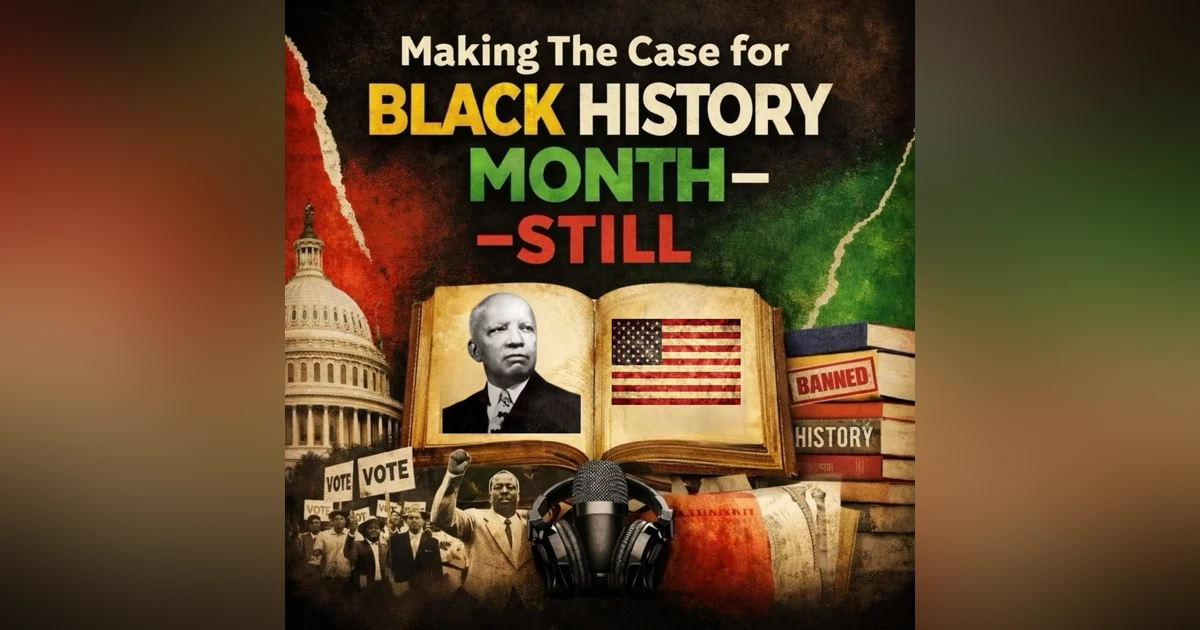
Is Black History Month still needed, or are we just treading water in a sea of sanitized history? Ayana breaks down the sneaky ways America is rewriting its story, erasing Black contributions, and turning the past into a sanitized fairy tale. Spoiler: It’s not over, and ignoring the ugly truths keeps us stuck in the same cycle of erasure and incomplete narratives. From executive orders trying to “restore truth” (lol) to museums that prefer a “positive-only” version of history, Ayana exposes how official efforts are systematically pushing Black history out of sight — and why that’s a slap in the face to real progress. You’ll discover how curriculums thin Black achievements into “firsts,” overlook resistance and ingenuity, and frame history as a series of “mistakes” rather than the complex, revolutionary stories they are. We break down how the race to “sanitize” history fuels societal divides, weakens civil rights protections, and leaves new generations with a version of America so polished, it’s almost shiny enough to blind you. This episode isn’t just about Black History Month — it’s about the importance of truth in shaping a better future. And yes, Ayana gets real — no sugar, no fluff, just the facts, figures, and the unapologetic truth. Because until we all know where we came from, we’re still wandering in the fog.
Read:
1. "African-Americans and Africa: A New History" by Nemata Amelia Blyden
2. "Mis-education of The Negro" by Carter G. Woodson
3. https://peoplenotproperty.hudsonvalley.org/the-presidents-house-site.php
4. https://www.whitehouse.gov/presidential-actions/2025/03/restoring-truth-and-sanity-to-american-history/
5. https://travelnoire.com/black-history-2026-celebrations
6.https://www.city-journal.org/article/presidents-house-site-independence-national-historical-park-george-washington
7. https://www.axios.com/2025/11/29/funding-cuts-erasing-black-history-blackout-report
8. https://time.com/6217162/teaching-white-supremacy-american-history/
Is Black History Month still needed, or are we just treading water in a sea of sanitized history? Buckle up — Ayana breaks down the sneaky ways America is rewriting its story, erasing Black contributions, and turning the past into a sanitized fairy tale. Spoiler: It’s not over, and ignoring the ugly truths keeps us stuck in the same cycle of erasure and incomplete narratives.
From executive orders trying to “restore truth” (lol) to museums that prefer a “positive-only” version of history, Ayana exposes how official efforts are systematically pushing Black history out of sight — and why that’s a slap in the face to real progress. You’ll discover how curriculums thin Black achievements into “firsts,” overlook resistance and ingenuity, and frame history as a series of “mistakes” rather than the complex, revolutionary stories they are.
We break down how the race to “sanitize” history fuels societal divides, weakens civil rights protections, and leaves new generations with a version of America so polished, it’s almost shiny enough to blind you. This episode isn’t just about Black History Month — it’s about the importance of truth in shaping a better future.
And yes, Ayana gets real — no sugar, no fluff, just the facts, figures, and the unapologetic truth. Because until we all know where we came from, we’re still wandering in the fog.
Read:
- "African-Americans and Africa: A New History" by Nemata Amelia Blyden
- "Mis-education of The Negro" by Carter G. Woodson
- https://peoplenotproperty.hudsonvalley.org/the-presidents-house-site.php
- https://www.whitehouse.gov/presidential-actions/2025/03/restoring-truth-and-sanity-to-american-history/
- https://travelnoire.com/black-history-2026-celebrations
- https://www.city-journal.org/article/presidents-house-site-independence-national-historical-park-george-washington
- https://www.axios.com/2025/11/29/funding-cuts-erasing-black-history-blackout-report
- https://time.com/6217162/teaching-white-supremacy-american-history/
Join the conversation by leaving a comment for the show on our social media pages!
Ayana Fakhir (00:01)
It is 2026, which makes 100 years since the advent of Negro History Week in the United States of America. Negro History Week is the predecessor to Black History Month, which was started in 1976 under then president Gerald Ford. Negro Negro History Week began as a correction, not a celebration.
And while we currently celebrate the month of February, the entire month, as some people will point out, the shortest month of the year, the record shows that we still need to correct the record. Black History Month exists because the American curriculum still refuses to tell the whole truth. In fact, is indignant, digging its heels in, 10 toes down.
against teaching diversity, against teaching the history of and contributions of black Americans to the infrastructure, social constructs, and et cetera of the United States of America. In fact,
In fact, while we currently celebrate it, as some will point out, it is the shortest month of the year, while we currently celebrate it, the record shows that we still need to correct the record.
Black History Month exists because the American curriculum still refuses to tell the whole truth. If black history were fully integrated year round in American schools, for instance, the month would be redundant. It is not. For more than a century, researchers reviewing US history textbooks have found the same pattern. Black life is minimized. Black resistance is softened. Black life is minimized.
Black resistance is softened, black achievement sidelined, and white supremacy framed as a series of misunderstandings rather than a deliberate system. The month endures not because black history is supplemental, but because the default narrative remains incomplete. And correcting that narrative is still unfinished work. I've got some explaining to do. Let's get into it.
All right, hey everybody, welcome back for another episode of Ayana Explains It, all the podcasts bridging the gap between current events and human behavior. I am your podcast host, Ayana R. Fakhir The R is for remarkable, naturally. I'm kidding. Yeah, I am your black Muslim lady lawyer who has an opinion on everything. I am the host, I am the producer, I am the executive producer, I am the key grip.
I am craft services, I am all things and more. Ayana explains it all is the podcast bridging the gap between current events and human behavior, although I'm thinking of changing that tagline. I'm thinking about it. I'm some things around. Ayana explains it all is available on multiple streaming platforms, including Spotify, which is my flagship, also Apple Podcasts, Amazon Music, Pandora, Good Pods,
Amazon music, good pods. We're on iHeartRadio.
We're on iHeartRadio. We also have our own YouTube channel. Yes, check out Ayana Explains It All on the YouTube. Just A-Y-A-N-A, explains it all on YouTube. We also have, I'm very proud of, my website. I'm not the best at website building, but it's nice. It's nice. Go over to the website, www.ayanaexplainsitall.com.
W W W DOT A Y A N A explains it all.com to find all things podcasts from every episode of the show from the beginning. This is the second episode of season five. If you checked out season one premiere, then you were greeted with something really hard hitting. It seems like I only do hard hitting. I only do hard hitting, honey. I don't do soft gentle, although that courage episode, I really like that. But anyway, yes, check out the website transcripts.
There's a blog, there's show notes, there's ways to get in contact with me. Email ayanexplainsitall at gmail.com if you want to get in contact with me, if you want to collaborate, if you want to co-host, if you want to be on my show, talk about anything you want. I know I talk about politics a lot, but I also talk about human development. talk about, in the past I talked a lot about parenting. I still do that. I have two kids. I'm still parenting. And whatnot. I've been a lawyer for...
This year will be 22 years. What year is this? I became a lawyer in 2003. So it'll be 23 years. My goodness. 23 years this year. I am currently in the public sector. So you know I ain't making a lot of money. OK? Although I would love to. So if you could please support my podcast, that would be excellent. Mama's got to put kids through college. Yeah. Go to the website and find out how you can support the podcast. Also.
If you want to send me an email leave a review or rating you can do that on the individual streaming sites or you could do that on the website again all things podcast at the website also I have been collaborating working with and I was just given a promotion To the with this group called Our Vote Counts We also have a YouTube Of the we also have a YouTube of the same name Our Vote Counts We are on every social media site Facebook threads Instagram
TikTok. TikTok is where we started. We do town halls, Q &A, TikTok live town halls with people who are running for political office. Okay? And this is any office. We do not discriminate. No, no, no. We are nonpartisan and we don't discriminate. We have talked to people who are running for city council, mayor, governor.
We're talking to somebody who ran for, who's running for comptroller, state Senate, US Senate, state House of Representatives, US House of Representatives. I interviewed somebody who's running for a county commission. I mean, we do it all, honey. All the things with the people, anybody who's running for office, who wants to get their message out there, but they don't have a lot of money, so they can't pay for these things themselves. They can't host giant town halls and they're not getting invited to these forums because they don't have
the support of the big parties, know, the big Republican, big Democrat party, and they need some help. And so we give them that assistance. We put them on TikTok, we do a Q &A, and then they can go on YouTube and they can use that video to show people, hey, look, I have a plan, I have a policy, I have a vision for the future of my state or my district, and I want you all to see it, I want you all to hear it, but I'm not getting enough press because I'm grassroots.
because you know, advertising and such costs money, a lot of money. So here you go. And we've been doing this since last September. September, 2025 was our very first one. Now we've done over a hundred of these, over 100. And I have moderated many, many, many, many. And I love it. I absolutely love it. I've learned so much about politics. I know a lot about government, obviously. I work in government, but I've learned so much about politics and policy. And I really be nailing these people.
Okay, I don't go soft on these people. If you're running for office, you gotta be tough. You gotta be. You just, it doesn't matter what office, you can be running for HOA. You gotta be tough. You gotta be tough. You gotta come with a plan. Don't be walking up in here thinking that little scribbles you wrote on your napkin there is gonna work. No, no, no, no. Not at all. So again, check out Our Vote Counts
you'll see me repost this on my social media. Again, I am on Facebook. I am on threads, Instagram. I'd be cutting up on Instagram. TikTok, go to my TikTok. You'll see me reposting information about our vote counts, information about myself and the podcast. And I'm doing these book recommendations now because again, reading, it's where all the answers are. All of the answers are in the books. Okay.
So I will, I do these little videos about getting people encouraged and people to read a book. One of my favorite apps is the Libby app. This is not an ad, but if Libby, if you want to work with me, I mean, come on now. I, I, I use your app quite a bit, quite a bit. Again, social media, where you can find me A-Y-A-N-A-F as in Frank, A-K-H-I-R. And if you can't pronounce it, don't blame me, blame my dad. Okay.
let's talk about what's going on. Listen, last year was a doozy, right? Last year, something happened in January of last year, and then out of the gate, everything started changing, and your head was dizzy, your head was spinning because there were so many changes, and none of them for the better, right? One of the changes was an executive order that was issued within months of a certain person ascending to the Oval Office.
And it's called the executive order is called restoring truth and sanity to American history. I don't think you can do that, but he tried. He tried it. And this was issued on March 27th, 2025. And I'll just read section one because that's all you need to hear. It says purpose and policy. Over the past decade, Americans have witnessed a concerted and widespread effort to rewrite our nation's history, but that he means telling the truth.
replacing objective facts with a distorted narrative driven by ideology rather than truth. I'm sorry. They're so full of shit. Driven by ideology rather than truth. Rather than truth. Okay, Ayanna, get it together. This revisionist movement seeks to undermine the remarkable achievements
of the United States. He means people like George Washington and Abraham Lincoln who were disgusting enslavers and genocidal maniacs. Anyway, this revisionist movement seeks to undermine the remarkable achievements of the United States by casting its founding principles, whatever the hell those are, and historical milestones in a negative light. Under this historical revision, our nation's unparalleled legacy of advancing liberty, individual rights, and human happiness is reconstructed.
as inherently racist it is by the way, sexist it absolutely is, oppressive yeah it is, or otherwise irredeemably flawed it is, it is, rather than fostering unity and a deeper understanding of our shared past, let me tell you something, shared past? Nigga I'm only here because your people kidnapped mine from West Africa and brought them here as slaves, okay anyway Ayanna come on, stay on track.
The widespread effort to rewrite history deepens societal divides and fosters a sense of national shame. Disregarding the progress America has made and the ideals that continue to inspire millions around the globe. You know, AI is something else. I can tell AI wrote this. Anyway, the prior administration advanced this corrosive ideology.
At Independence National Historical Park in Philadelphia, Pennsylvania, where our nation declared that all men are created equal. The prior administration sponsored training by an organization that advocates dismantling Western foundations and interrogating institutional racism and pressured National Historical Park Rangers that their racial identity should.
dictate how they convey history to visiting Americans because America is purportedly racist. Now, what they mean by that is George Washington's, the president's mansion in Philadelphia, right? The exhibit, the exhibit was finally put together in 2010. It was decided to become an exhibit in 2010. I don't know what they're talking about previous administration. What the hell ever, under the Biden administration, some, facts.
were added to the exhibit that certain people don't like. And those facts were about the people who lived in that house with George and Martha. It was their slaves. It was their slaves. And the previous administration decided that the names, the identities of those people, their lives should not be erased. And Philadelphia, being what it is, a mostly black
metropolitan city should include the facts about those black people who were forced to live at that mansion and serve at the behest of the first president of the United States. Now, some will say he only kept those people there because he had his mistresses at the other house.
Anyway, it goes on and on and on to talk about how, people are forced to read about slavery and genocide when they go visit the national parks and they shouldn't have to do that. They shouldn't have to learn about the Trail of Tears and that Medgar Evers was murdered by a racist white supremacist when they go to visit the house. They should just learn about the sanitized version of America and we shall overcome and we overcame and everything's changed now. We got to the mountaintop like Martin Luther King said.
Listen, they have decided to gut the National Museum of African American History to correct the historical happenings of the civil rights movement in the history of blacks in America. says, the National Museum of African American History and Culture has proclaimed that hard work, individualism and the nuclear family are aspects of white culture. The forthcoming Smithsonian American Women's
History Museum plans on celebrating the exploits of male athletes participating in women's sports. They mean trans women. These are just a few examples of the abhorrent material at these museums. Let me tell you something.
The nuclear family was an aspect of white culture. That was some European shit that survived enslavement and reconstruction and the Depression and wars and all that. If you, you know, just pick up a book, okay? Just one book I will recommend is African Americans and Africa, the New History. And in that book, the author talks about what aspects
of African culture looked like, what different aspects of the culture looked like before they were brought to the United States and forced to conform to this European way of living, what their communities looked like, what marriages looked like, what family structure looked like, what their homes looked like, what the political hierarchies were, what the religions were. A lot of these things they brought to the new world with them.
And some of them held on to them, like some of them held on to the religion of Islam strongly, even while being forced to read the Bible and go to church and et cetera, they held on to it. They also held on to some of their different music and dancing and way of dressing and head wraps and all. It's an excellent book. Excellent. I mean, please read it. African Americans in Africa, the New History. So the nuclear family,
was actually European. That was white culture. It was. That is not a lie. That is not hyperbolic. Okay? If you're uncomfortable with the truth, then perhaps you should seek to understand why people feel this way rather than trying to tell them that how they feel is incorrect. How they, how we feel about this particular thing.
is the truth. There was no nuclear. The nuclear family looked different in Africa. It looked different. Sometimes in certain tribes, certain society, women were the head of the family. Sometimes women went to war. Sometimes the family was the mom and dad and auntie and uncle and grandma and grandpa. That was the family.
It wasn't mom and dad, sis and bro and dog and white picket fence and house in suburbs in Connecticut. It was very different in West Africa, particularly. Don't see this is why. And this is what this episode is about. This is the episode is about if black history month is still needed. And yes, yes.
It is indeed, because y'all still don't know what the fuck. I'm sorry. I do cuss a lot. Deal with it. I don't know. So what they decided to do under the behest of the president of United States of they're going to go around and they're going to remove any information they don't agree with on these exhibits. You know, if you go to a national park, we have a...
Not a national park, but it's a it's a park here the Cuyahoga Valley National, whatever anyway, I can't remember the name But it's a it's under the national park system the Cuyahoga Valley National Park. I think it's called I ain't got the exact name Okay, forgive me blame it on my brain not my heart but All of these parks contain information on how the park was formed founded who owned it first before it was
as I guess you would say now, hand it over to the US government. All of these things fall under the Department of the Interior. The National Park System falls under the Department of the Interior. You go to the Grand Canyon, you're probably not going to learn about the Native American or indigenous people who live there, how they got there, how they were forced there, how this land was taken from them. You're not going to learn about that anymore because
that kind of information is hurtful, it's harmful. It's harmful to the U.S. It erases the great accomplishments that we've achieved in making this giant rock formation our own. Can you imagine? It doesn't mention the hard fought battles that the generals fought against the indigenous people and how they tricked them out of their land, stole their land, killed them off with their diseases and their bombs and their muskets and whatever.
Anyway, you don't want to hear about that. It's disturbing. They don't want you to know. It hurts their feelings. It hurts their feelings. So they're removing all of that. If you go to a museum, you're only going to hear positive things. They only want you hear positive messages about the United States. Positive. So you'll feel good about your country, right?
Which is funny because you could go to a museum and read all the positive shit you want to. And then you turn on the news and you see ice barging into people's homes or paratrooping into people's apartments from helicopters and yanking babies out of their beds. And you think, Hmm, let's start contrast to what I just read at this museum about how civil we were with people who immigrated here and how civil we were.
when we arrived on these shores and made friends with the natives and how civil we were during the 1900s to the blacks and how civil we were to the Japanese and the Vietnamese and such as. Like, I mean, they think we're dumb. Well, okay, I'm not dumb.
Some of y'all.
Some of you are a bit naive. Some of you are easily led astray. I'll say that. Some of you are easily led astray. Okay? Not me. Not me since birth. Okay? So yeah, he wants to save the Smithsonian and save the national parks. He even put his face, he put his face on the national parks card. You know, you get a membership pass to visit the national parks.
They changed the rules to that too, by the way. They increased the prices. now, something about if you're not a citizen, you have to pay more, or you can't get a pass or something, but he put his face on the card. The national pass, you get a card, he put his face on it.
Yeah, so there's that. But he directed the vice president of the United States and the director of office and management and budget to work with Congress to ensure that future appropriations of the Smithsonian Institution, I mean, if they don't want there to be a museum, there won't be. So the Museum of Hispanic Latino History that was being built shut down. No more. No more.
He wants these museums to celebrate the achievements of women, real women, not them trans people. He wants it to celebrate the achievements of these generals and these soldiers of the Civil War and the Spanish American War and the Vietnam War and World War I and World War II and enslavement. He wants to celebrate the achievements of Andrew Jackson. Isn't it enough that that disgusting genocidal maniac is on the $5 bill?
yeah, by the way, Harriet Tubman ain't going on the $5 bill. Sorry. Yeah. Isn't it enough? Isn't it enough? No, no, no, it's not enough. No, it's not enough for them. They want you to think about America in terms of all of the positive achievements.
this is me trying to think of the positive achievements. Well, me, I mean, I was born here. Anyway, this isn't about me. This is about history. I'm a fool, y'all. When I read this executive order, I was cracking up. If you are a student of history, American history specifically, then you know that there are parts of it, many parts.
many, many, that are nasty, ugly, disgusting, horrific, horrendous, terrible. And there are some parts like maybe the Industrial Revolution was nice, right? Andrew Carnegie and all them other people building up these steel factories and making America a rival of Europe. And then after World War II when America was the leader of the free world because we freed Europe and we freed
Japan and we rescued the Jewish people that we tried to turn away when they were about to be put into the ovens anyway. Yeah, leader of the free world. Yes.
So you know that there are some parts of this that are just really ugly. I guess what the president has decided, I guess what President Trump has decided is that it's enough of learning about that, which is funny because he doesn't know any of it. You ask him a question about US history, he couldn't tell you. He couldn't tell you. I mean, how can you say it's enough when you don't even know? You don't even know. But I'd like.
So my question is whether Black History is still Black History Month is needed and basically the critiques of that because the usually, usually you will see some celebration of Black History Month and the different federal offices and you will see some posts by the president, the office of the president and the federal government on social media. Usually you don't see that anymore. You don't see that.
They don't see it anymore. They don't give a damn. They'll be like, it's MLK Day. He's so inspiring. we continue to carry on the message. They barely acknowledged Dr. Martin Luther King Jr. Day. If they could get rid of it altogether, they would. Altogether. If they could get rid of Black History Month altogether, they would. No, it's not necessary anymore. We've overcome. We overcame.
We shall overcome. We overcame Ayana. The overcoming is done.
And every year, like clockwork, every year, lately, by lately I mean since maybe Obama was president, is Black History Month still necessary? Is Black History Month still necessary? it still necessary? We still need this.
And I want to be honest about what that question usually means. Most of the time it's not curiosity, it's frustration, it's fatigue. It's the belief that we've already dealt with this part of American history and should be able to move on, right?
And in the past year, and in the past few years, we've seen federal, state, and institutional policy and legislative decisions, policy and legislative decisions that have essentially gutted major pillars, I just read you one, of America's civil rights protections and racial equity infrastructure. And according to this article in Axios,
Right? And you can, you've seen this everywhere. It says in the past year, federal, state and institutional decisions have gutted major pillars of America's civil rights protections and racial equity infrastructure, wiping away public data, slashing research funding and erasing black history.
And this is essentially a coordinated rollback that operates on multiple fronts at once. the through line is simple. If you erase the data, defund the research, and suppress the history, then you can deny the harm, right? So here's what that minimization actually looks like in practice. Eliminating the agency. When agencies stop collecting,
or publishing data on race, policing, housing, health disparities, or educational outcomes as we're seeing now, they're not being neutral. They're removing the very tools communities use to prove discrimination, track inequity, enforce civil rights laws, and hold institutions accountable. Without that data, injustice becomes unmeasurable and therefore easier to ignore. So again, is Black History Month needed?
is information on the particular race of a community or how people of a particular race are treated in a community needed. Well, yes. But they're also defunding the people who study inequity. Because again, do we even need this anymore is the question that conservatives mostly are asking. Research centers, as we're seeing, DEI offices, civil rights units, and community-based programs
are being stripped of funding, staff, legal authority, and access to public records. And this doesn't just slow progress, it dismantles the infrastructure that identifies problems before they become crises.
They're also criminalizing and restricting the teaching of black history. So when states ban books, as we have seen in many states, banning of Maya Angelou's books, Toni Morrison's books, books from authors who are black and gay, they're even banning the diary of Anne Frank. So when you do that, you're doing more than just rewriting lessons. You're narrowing the public imagination.
You're severing young people from the tools to understand their own country. You're making it harder to name patterns of discrimination when they reappear. And then that erasure becomes a form of policy. But they're also using this, using these rollbacks to reverse or weaken civil rights protections. Again, the courts are asking, the Supreme Court currently asking, are parts of the civil, are parts of the Voting Rights Act?
of 1965 still needed.
So changes to voting rights enforcement, fair housing rules, affirmative action, and anti-discrimination guidelines all have the same effect. Fewer protections for certain groups, fewer remedies for wrongs, and fewer avenues for justice. It's a shift from we will protect your rights to you're on your own. And then becomes
the replacing of equity with rhetoric. When institutions claim that they're removing politics or removing divisive information or they're trying to restore neutrality, but neutrality in a structurally unequal society is just the status quo with better branding. The rollback, Donald Trump's rollback is framed as
administrative housekeeping, trying to clean things up, trying to make them look neat and nice, when in reality it's a political project with racially material consequences. Not just racial, but gender, ethnic consequences.
And when they say, these things needed? Most of the time, it's not curiosity. Again, it's frustration. So I'm not gonna, this episode is not a celebration of Black History Month, unfortunately. It's a response to the question of whether these things are still needed. Is Black History Month still needed? And that flows into whether civil rights protections are still needed, whether the Civil Rights Act and the Voting Rights Act are still needed.
whether we still need to protect Native Americans, whether we still need to protect indigenous groups, whether we still need to protect people who are discriminated on the basis of gender, ethnicity, immigrant status, immigration status, whether we still need to protect people, these vulnerable groups, disabled people, for instance. And the answer is absolutely 100 % yes. Yes. You are not living in a country that is
now completely safe for everyone. cannot look at what has happened recently in Minnesota and say, yes, this place is completely safe for everybody. Everybody feels welcome here. Everybody is welcomed here. No, that is not the truth. And the targeting, for instance, of Somalians and Haitians is strictly because they are black, because they are black, because they are black and poor.
But first, because they're black. Second, because they're poor. If they were wealthy blacks, well, maybe. Maybe they could get a pass. But then they're also black, so no.
but it's the fact that they are also poor that makes it even worse for them. If there's one thing that elitist hate is a black person, if it's another thing that elitist hate is a poor black person, you can disagree all you want to, but honey, the answer is in the books, okay? But the truth about all of this, whether Black History Month is still needed, Black History Month was never created to make anyone feel proud.
guilty, inspired or affirmed in the first place. It was created because American history, specifically how it was taught and understood was structurally incomplete. Right? Carter G. Woodson, who wrote Miseducation of the Negro, which you should absolutely read, fascinating book, talks specifically about how he created Negro history week.
because he wasn't looking for representation. He was a rigorously trained scholar with a PhD from Harvard. He wasn't looking for representation. His concern was simple and devastating. American schools were teaching a version of history that erased black people almost entirely.
And in his book, The Miseducation of the Negro from 1933, Woodson argued that when a people are written out of history, the damage isn't symbolic, it's structural. One group learns a false sense of superiority. The other learns a false sense of inferiority, and both are miseducated. At the time when he wrote that book, The Miseducation of the Negro,
Mainstream textbooks routinely credited economic development solely to white industrialists. Westward expansion without enslaved or coerced labor. Democratic growth without acknowledging who was legally excluded from voting property ownership or citizenship. Like what Donald Trump is currently trying to do with that executive order.
In fact, Negro History Week, again, it is the 100th anniversary of Negro History Week. It was a corrective, a forced interruption of that false narrative. And it was never meant to be permanent either. It was never meant to be permanent. As he literally called it the miseducation, he had evidence of how the system worked. But he also concerned himself with the representation of
Africans and European writings, how it minimized or even ignored their contributions to science, the arts, language, religion, and engineering. Notice I said Africans. He talks about Africans a lot in the book, Miseducation of the Negro, because that's how we were brought here to the United States. We were Africans brought to the United States, to the new world. Before it was the United States.
We were Africans brought to the US. Before it was the United States, we were Africans brought to the new world. Yet our contributions, yet our contributions to this country were completely denied, completely ignored, completely glossed over.
not talked about in history books whatsoever.
But Woodson's explicit goal was integration. Yeah, it was integration. Something that some black people just, the thought, the idea, my God, we should have never integrated. It was better that we didn't integrate. Woodson's explicit goal was integration. Making black history impossible to separate from American history.
So the expansion to Black History Month in 1976, which it is now the 50th anniversary of Black History Month, which was endorsed by President Gerald Ford, it was not a victory lap. No. It was an admission that the problem, the problem we sought to fix with Black History Week still hadn't been fixed. And this context
matters. It wasn't Negro History Week because we wanted to celebrate the achievements of black people. It was Negro History Week because the achievements of black people were being left out of the narrative of the United States. It wasn't being taught in the schools. It was being erased and black people were being sold as inferior to whites.
Carter G. Woodson had hoped that black history would become so weaved into the fabric of American history that we would need a Negro History Week, certainly not a Black History Month, and that is not the case. And it's not even the case 100 years later, 50 years later. It isn't.
And while some may say, it is, it's pastime. Black history is American history now. It's taught in schools.
We already teach this, Ayanna, do we?
Do we? We already teach Black history, Ayanna. We teach about slavery, enslavement, the Civil Rights Movement, Martin Luther King Jr. That's not Black history. That's not Black history. It's a narrow narrative frame. It's what you've decided is palatable to children in our society, what you are able to comfortably explain.
So that's what you present to them. But you could never tell the whole story of slavery because it is too agonizing and disgusting and despicable, dirty, gross, abhorrent. You could never tell the whole story. You cannot sanitize American slavery. You cannot sanitize the slave trade. You cannot do it. And you shouldn't. You shouldn't.
national reviews of your national reviews of US history curricula including analyses by the National Council for the Social Studies including analyses by the National Council for the Social Studies and long study national reviews of US history curricula including analyses by the National Council for the Social Studies
and long-standing critiques from the National Education Association show that Black history is overwhelmingly confined to slavery and mid-20th century civil rights. And what is missing from that narrative?
black political theory during Reconstruction, black labor organizing in the late 19th and early 20th centuries, black farmers, educators, diplomats, economists, and legislators, black resistance outside the respectable narratives. And this matters because history shapes interpretation. If black Americans only appear as enslaved people or protesters,
asking for inclusion, then modern disparities look cultural instead of policy driven.
And they are certainly policy driven. That's how you get confusion about voting rights. That's how you get backlash to civil rights enforcement. That's how people genuinely ask why inequality still exists. History answers those questions if it's taught fully. But it isn't.
Another critique, perhaps, of Black History Month would be, why make history about race? History is just history. We should make it neutral. And that sounds neutral, right? But it isn't. American history has always been racialized. How could it not be?
What changed is which perspective got labeled universal, right? Now go with me. After Reconstruction, a school of historians known as the Dunning School reframed the Civil War and its aftermath to portray Reconstruction as a failure caused by black incompetence rather than white resistance.
White resistance was the actual reason Reconstruction failed. And that interpretation that Black people were the fault dominated textbooks for decades. That's not neutrality.
But that's not neutrality. That's ideology successfully institutionalized. White experiences became the default. Black experiences became special topics. So when Black history is introduced, it feels political, not because it is, but because it disrupts a longstanding imbalance. And Black History Month exists to interrupt that imbalance.
Not emotionally, but factually.
So let's deal with another critique of Black History Month. Black History Month has become shallow and performative and should be discontinued as a manner of speaking. And to an extent, it has become performative. People post their memes and their little quips, their comedic quips about Black History Month and their cartoons that deal with Black History Month.
There are, you know, skits that deal with Black History Month. But just because people have decided to use it to make money or use it for entertainment doesn't mean that it's unnecessary.
It just makes institutional failure more visible to the masses. When schools and corporations limit black history to february, assemblies, posters, or trivia, they're demonstrating how resistant they are to structural integration. And this has precedent in history, right?
After Brown v. Board of Education in 1954, many school districts technically complied while resisting meaningful change. They made symbolic gestures instead of substantive reform. And Black History Month often functions the same way. We take out this month to finally teach the kids about Harriet Tubman and Sojourner Truth and Frederick Douglass, and then the rest of the school year.
You don't hear nothing else about these people. You don't hear anything else about black thought, black scholars, black engineers. You don't hear anything about the contributions of Garrett Morgan. You don't hear anything about Jesse Owens.
problem isn't Black History Month, it's the containment of Black History to a month.
And if you were posed this question about whether Black History Month is still needed by a conservative, I want you to respond in the following manner.
what often gets labeled as politics.
when it comes to talking about Black History Month is simply historical context. It's not politics to talk about race when you talk about history. It's historical context. Teaching that slavery existed isn't controversial. It is the truth. Teaching how slavery shaped labor markets, voting laws,
housing policy, criminal justice, capitalism.
is not controversial. It is the truth.
Their discomfort with it is not the problem.
Their discomfort with it doesn't make Black History Month controversial or unnecessary.
their discomfort with it is that it implies that they had something to do with slavery, civil rights violations, denying black people the right to vote, genocide, homicide, racial injustice. It's the implication that makes them uncomfortable. And they'd rather not, they'd rather not even have to think about.
that maybe their ancestors could be implicated in something so terrible.
Why are you trying to make us feel guilty about being white? You're making the white kids in schools feel guilty. You're making the white people feel guilty.
But guilt is not caused by honest history. It's caused by silence followed by shock. When children learn early that systems and not individuals shape outcomes, which is the truth, they are better equipped to understand complexity without defensiveness.
We should teach black history year round. We should not have a special month, but it's not being taught, but it's not being taught year round. It is confined to a special month because that is what is most comfortable. That is what is most comfortable and palatable for the whites of America. There, I said it. That is what is most comfortable for you.
What is safest for you? What is most, since you want to call it politics, politically expedient for you. It just makes sense only to talk about black history in February because you know, that's black history month lets you off the hook from having to integrate black history into American history and talk about it all year round.
The truth is that without Black History Month, much of Black history disappears from conversations entirely. Disappears from schools, disappears from universities, disappears from workplaces, disappears from thought, from conversations, from online discussions entirely.
And this debate over where the Black History Month should exist, it isn't happening in a vacuum. Periods of racial progress in the United States are routinely followed by periods of historical retrenchment. I've talked about this before. We saw it after Reconstruction. We saw it after the Civil Rights Movement. And we're seeing it now. Policies are being narrowed. Curriculums, school curriculums are being narrowed.
Discussions of race and policy history are being restricted. Teachers are being told what not to contextualize. Historical context is being removed to create a sanitized version of very American narratives about enslavement, prejudice, bigotry, human rights bites.
At its inception, the United States was a nation that enslaved one group of people while committing a genocide against another. That is the truth. That is the truth.
That is the truth.
In that environment, Black History Month becomes one of the last protected spaces for certain truths.
So when people ask why it still exists, what they're often asking is, why hasn't this gone away?
And our response should be, because the work isn't done. Minimizing the role of Black contributions isn't just about leaving things out. It's about shrinking, flattening, or sidelining the impact Black people have had on every dimension of American life. It turns a central, generative force in this country's history into a footnote.
When textbooks and curriculum minimize black contributions, they often do it in a few predictable ways. By reducing black achievement to a handful of firsts, by framing black innovation as exceptional rather than foundational, by ignoring black intellectual traditions, or by presenting progress as something granted by white benevolence, rather than built through black organizing labor, creativity, and resistance.
The result is a distorted narrative where black people appear only in moments of suffering or protest rather than as architects of culture, democracy, science, industry, and political thought.
To minimize is to misrepresent, to make something seem smaller than it truly is. And this is the context.
Minimizing the role of Black contributions isn't just about leaving things out. It's about shrinking, flattening, or sidelining the impact Black people have had on every dimension of American life. It turns a central, generative force in this country's history into a footnote. When textbooks or curriculum minimize Black contributions, they often do it in a few predictable ways.
by reducing black achievement to a handful of firsts, by framing black innovation as exceptional rather than foundational, by ignoring black intellectual traditions, or by presenting progress as something granted by white benevolence rather than built through black organizing, labor, creativity, and resistance. The result is a distorted narrative where black people appear only in moments of suffering or protest.
rather than as architects of culture, democracy, science, industry, and political thought. To minimize is to misrepresent, to make something smaller than it truly is. And in this context, it means telling an American story that is incomplete by design.
Pennsylvania Governor Josh Shapiro said the following, if we want to move forward as a nation, we have to be willing to tell the full story of where we came from. And this was in response to the National Park Service's decision to remove signs at the President's House site at Independence National Historical Park.
as a first step toward redesigning the exhibit that I talked about at the top of the episode.
We have to know where we came from.
You know, one of the beauties of being Muslim.
is that we're constantly learning about the history of Islam and Muslims in the world. We're constantly learning about the history of prophets and the advent of earth. If you're into religion and you read religious texts, you learn about all of the early times. Well, in Islam, you never stop learning. You never stop learning where you came from as a Muslim. You never stop learning
about the traditions of the companions of the Prophet Sallallahu Alaihi Wasallam. You never stop learning. It's never not taught. It is constantly taught every day, every day. And that is because we need to know where we came from, but also where we are going. We need to know where we are going. And some of us need constant reminders of where we are going.
Some of us need constant reminders of how we got here.
We didn't just appear. This didn't just happen. Everything is shaped by something. Everything is shaped by something.
Everything is shaped by something.
America, the United States of America is shaped by many things. And you can't leave out part of that because it makes you feel uncomfortable. There are things that we have to confront. We have to know.
Because then when you look at where you are, can go, my God, we survived all that and we're still here.
So yes, Black History Month is still necessary. Not because Black people need a month, but because American history still hasn't fully told the truth about itself.
Black History Month is not about adding black people to history. It's about correcting the record. And the moment this country teaches its history honestly, consistently, and without fear, this month of black history will become unnecessary.
Until then, the problem is not February. It's everything that makes February necessary.
And this has been Ayanna Explains It All brought to you by Facts, Figures, and Enlightenment. Take care.