

Spin Cycle: America's Political Laundry
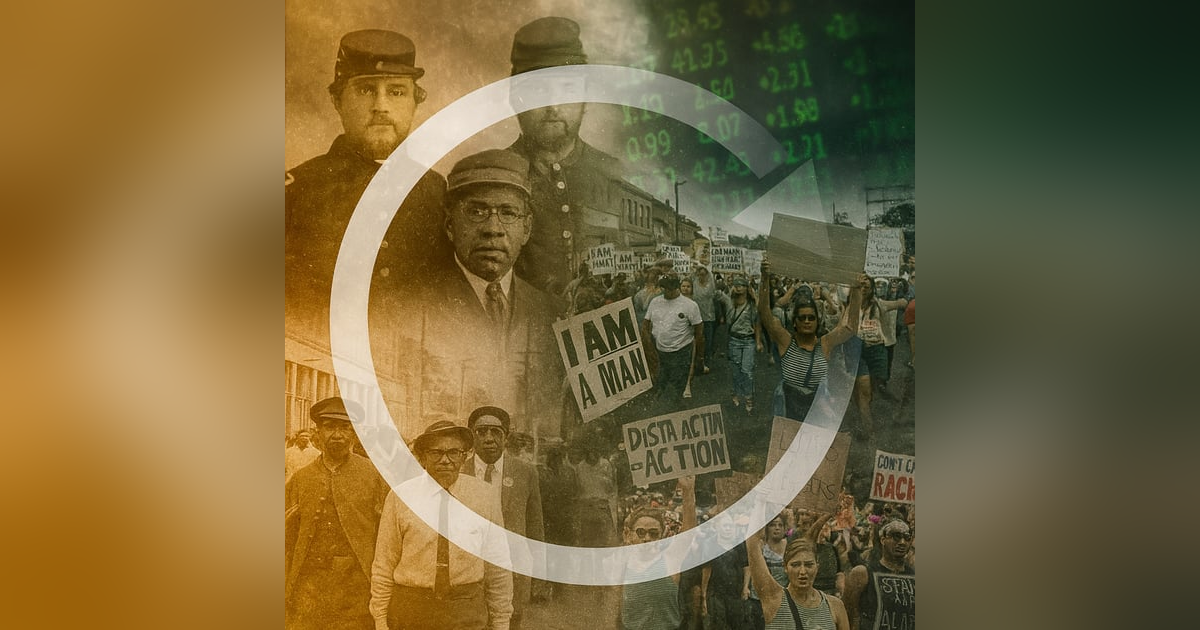
In this episode, Ayana explores the cyclical nature of American politics, highlighting how history often repeats itself through recurring themes of conflict, reform, backlash, and renewal. She emphasizes the importance of recognizing these patterns to transform them into spirals of progress, urging listeners to learn from the past to foster a more just and stable future.


Join the conversation by leaving a comment for the show on our social media pages!
Ayana Fakhir (00:00.046)
American politics often presents itself as a story of progress, a march toward greater liberty, equality, and justice. Yet when we look closely, the narrative is less a straight line and more a circle, revisiting old battles and new forms. From the earliest debates between Federalists and Anti-Federalists to today's disputes over voting rights and federal authority,
History repeats itself with striking regularity. The actors change, the language evolves, but the underlying conflicts remain familiar. I've got some explaining to do. Let's get into it.
Ayana Fakhir (01:05.837)
Hey everyone, welcome back for another episode of Ayanna Explains It All, the podcast bridging the gap between current events and human behavior. I am your black Muslim lady lawyer, host Ayanna R. Fakir. The R is for ravishing. I'm ravishing, darling. Actually, I'm freezing. It's cold in Ohio. I'm coming to you pre-recorded on December 10th, 2025 from Northeast Ohio. It is snowing again.
I think this is going to be a heavy winner and I can't take it. I can't. I'll have to because this is where I live and work, but I can't take it. Ayanna explains it all as the podcast bridging the gap between current events and human behavior. Not always on time. You know, I'm getting to the point where I really got to think about the things that I'm talking about and it takes a lot of reading and a lot of writing to formulate an episode. And so it's taking me longer in between episodes.
I'm not out doing a lot, so my experiences lately have just been about, you know, talking about politics, talking about politics over and over and over and over. So lately that's what the podcast has been about politics. This has been an interesting year for politics and government. Next year, it's going to be worse, maybe better, hopefully. I don't know. Ayana Explains It All is available on multiple podcast streaming platforms as well as music streaming platforms. We are on our...
flagship Spotify. We are also on Amazon Music, Apple Podcasts. We are on Good Pods. We are on Pandora. We are on our website, www.ayanaexplainsitall.com. That's www.ayanaexplainsitall.com. You can find all things podcasts, including show notes, transcripts, which I update all the time.
You can find ways to support the podcast. You can find all of my social medias. You can find the show's social medias. You can find info about how to collaborate with me. I do accept co-hosts. I understand that, you know, this is kind of like a hobby, kind of like a money-making thing for me. what, whatever the wind blows, okay? Wherever the wind is blowing, east, west, north, south, I welcome people to join me on the show to talk about whatever they want to talk about also.
Ayana Fakhir (03:29.941)
If you have some feedback about the episodes, I appreciate that as well. You can leave that at the show's website. Or you can leave me a message on our social medias. We are on TikTok, threads, Instagram, X. We are on Facebook. Leave me a message. Leave me a DM. Leave me a message. Be nice to me. I am a struggling single mom of two kids who run me ragged. Literally have me pulling out my hair. Please be kind. Be kind.
Again, go to www.ayanaexplainsitall.com to find out all things podcasts and ways to support the show. I would appreciate it. I love all of you. Thank you for being here. Thank you for listening. I know I talk about politics a lot. There's a reason for that. There is a very good reason for that. It is because that's all I read about. That's all I read about. That's all people want to talk about when they talk to me.
I'm on TikTok live panels and that's all people want to talk about. They want to talk about Trump and the federal government and the state government and Mike DeWine, which is Ohio's governor. They want to talk about city matters. They want to talk about county matters. mean, my goodness, government politics, government politics. Never mind the fact that I did major in government in college. So I should want to talk about it all the time, right? I also love to talk about the human experience.
The human experience, because I am a human.
I like to talk about parenting because I am a parent, again, of two kids who are running me ragged. But I am also a woman, so I like to talk about women's issues and women's stuff, womanly stuff. I should do an episode on perimenopause. Would anybody be interested in hearing that, hearing me complain about perimenopause? Like, I wake up with the freaking night sweats. Like, I go to sleep just fine, you know? Just fine.
Ayana Fakhir (05:32.574)
And then around, I kid you not, 3, 3.30 a.m. in the morning, boom, awake. And I'm usually sweating. And the awakeness is for no reason whatsoever. Is that the witching hour? Apparently this is something that happens to most women in perimenopause, 3 a.m.
It's like your body gets a couple hours of sleep and it's like, okay, time to be awake now. Hey, let's go see what's happening in the kitchen. Let's go see what's happening under your bed. Let's go see what's happening in the hallway. Just no reason whatsoever. Anyway, I wanted to talk about this topic today because people have been getting on my nerves. No surprise, Ayanna, no surprise.
with how stunned they are by all of the things that are happening in government and politics. And I'm just sitting back like, my God, are you people new? Are you new here? Are you new to Earth? Are you new to the United States? Are you new? Everything that is happening now is something that has already happened, probably three, four, five, six times, okay?
It's already happened. There's precedents. There's history. It's already happened. know, a lot of these politicians, especially the one who was currently the head chief executive in the White House, they're unoriginal. Him in particular, he is an unoriginal buffoon. He's cruel and boring. Whatever he comes up with, somebody already did it, probably did it better. I can't say that they did it worse.
Because he's actually really bad at doing the things that other people have already done. But a lot of people complaining about, rightly so, rightly so, a lot of the people complaining are young people. And they weren't born until like 2001, 2002. So perhaps they have not gotten to this part of their, they haven't gotten to this part of their history class.
Ayana Fakhir (07:46.078)
curriculum in college or high school or whatever, they haven't quite gotten to this part. Or maybe they skipped class that day where they taught all of the stuff that happened before they were born or all of the things that happened in past presidencies. People, for instance, again, rightly so, are complaining about the ICE raids. Yes, absolutely. Complain, protest.
do all the things, but I hate to break it to you. ICE has been doing this, what they're doing. They've been doing it. They have been doing this for years. ICE has been around since, what is it, 2002? When the USA Patriot Act was passed, 2002, 2003, and ICE was created, the Department of Homeland Security was created.
Money was thrown at them. Money, money, money, money, money, money, money, millions, now billions of dollars. When George W. Bush left office and Obama came into office, child, he inherited a law enforcement body that is ICE, that had the largest budget of any law enforcement body in the country and the third largest in the world.
Don't fact check me. No, go ahead. Go ahead, please. ICE has the budget, the third largest budget of a law enforcement body in the world. Last time I checked, it could be larger because again, a budget was passed and they were given even more money. They're given even more money. What is their sole function? What is their sole function? Round some jiggas up.
and put them in detention centers, round them up, deport them. That's all they do. That's all they do. They go around, they're like, they're goons, you know? When ICE hops out of their vans, it's like a caravan of idiots, you know? We're just here to arrest people. Get out of our way. Just a caravan of stupid rolls up. They just want to pick people up. They're bounty hunters for the government.
Ayana Fakhir (10:12.617)
And under Obama, were... I won't say they were given permission to because they certainly weren't. They were supposed to only be going after the criminals. That's what ICE is. customs, immigration customs enforcement, they're only supposed to be going after criminals present in the U.S., right? That was their instruction from the Obama administration. What did they do? They went after everyone, anyone they could find.
criminals, non-criminals, people they weren't giving people due process at the immigration court level. People were being denied interpreters, they were being denied lawyers, they were being denied phone calls. All of this was happening and President Obama was focused on the economy. And yes, please focus on the economy because we were in a deep recession, deep recession. And if we had gone any deeper, it would have impacted the entire world.
So he was distracted. He had Janet Napolitano as the head of DHS, the Department of Homeland Security. She was the secretary of the Department of Homeland Security during Obama's first administration. Maybe the second too. She was in charge. And she was like, okay, we're going to, you know, rustle up some immigrants, get some baddies out of the US because, you know, George W. Bush is out of office now. We can go back to...
operating as normal as we possibly can because we had the wars, we had Afghanistan, we had Iraq, but we also had reeling from Hurricane Katrina, all of these things going on. We were still trying to recover from 9-11. All of these things were happening and the economy, I mean, just had completely crashed because of the subprime mortgage crisis.
She was like, hey, go get the criminals. ICE was like, yeah, criminals, sure. They were tricking people into opening the doors to their businesses and houses. They were doing things without warrants. They were unchecked, unfettered, all over the country doing whatever the hell they wanted to. And in the first, Obama's first year, first year, why they called him Deporter in Chief, first year, they had captured
Ayana Fakhir (12:40.104)
over 390,000 people.
390,000 people. Now, if you think there were 390,000 immigrant criminals in the United States, you're a fool because there weren't. They were rounding up anybody, taking anybody, people who had simply overstayed their visa. You know, that's a civil penalty. It's not a crime. They put you on an airplane, send you out of here. They were arresting people and detaining them. Students, workers,
undocumented workers, people who had student visas, people who had H-1Bs, fiance visas, permanent residents, green card holders. Permanent residents and green card holders are the same thing. Anyway, they were gathering up anybody.
They had to do expedited removals, fine. Those people could go. But there were people who were not on any list to be removed because they hadn't been adjudicated for removal. And ICE was like, we don't care. They told us to get some immigrants. We're going to fucking cut these immigrants. That's what they did. And they kept doing it and kept doing it and kept doing it. And then it came to
the point of separating children from their parents, which was how the Obama administration left and Trump was brought in. He continued it and made it worse to the point that the United States was sued by people who were separated from their children. And we had to settle those lawsuits in a class action. There is precedence for everything that happens in this country. I know we're only...
Ayana Fakhir (14:31.719)
What are we? We're almost 250 years old. Like next year, 2026 is our 250th birthday.
But in those 250 years, the only original thing we've done is to create the separation of church and state. That's it. That's the only original thing. My God. The Bill of Rights. We'll take the Bill of Rights. That was the only original thing we did. The freedom of press, freedom of religion. That was the only...
But that was us. We made that. We did that. We did that.
Ayana Fakhir (15:17.251)
But especially the separation of church and state was our original idea. We created a separate nation to get away from the crown. We didn't create an independent nation. We wanted to be separate from the crown. And so we fought a war, won the war, declared our independence. And here's the constitution. Here's the Bill of Rights, the very first. Congress shall make no laws establishing the former religion.
That was us.
And then everything after that was capitalism built on the backs of American slaves, segregation. was slavery, segregation, slavery to reconstruction, wealthy white Europeans coming into the US or inheriting money and aggregating wealth, building wealth.
excluding blacks, excluding immigrants, but using immigrant labor to build things. Again, more wealthy white Europeans coming in, industrial revolution, president, president, war, war, war, war, Power struggle, power struggle, power struggle. Political party, political party, party lines, blah, blah, red states, blue states, purple states. And it's just been a cycle. It's just been, and it's just been a circle. We've been going around in a fucking circle for 250 years.
Ayana Fakhir (16:49.796)
Consider the debate of federal versus state power, right? And this is gonna sound so intellectual and smart, but I guarantee you, it's basic knowledge if you, you you read books, I read books. Well, what you want me to do? In the 1780s, anti-federalists warned that a strong central government would trample local autonomy. Their concerns echoed in the
successionist rhetoric of the Confederacy and resurfaced during the civil rights era when southern states resisted federal desegregation mandates and appeared again right now in disputes over health care mandates, environmental regulations, and election laws. Each generation confronts the same tensions. Convinced this is new, yet the cycle is centuries old.
As I said, nearly 250 years. Or take the struggle for racial equality, my God, today. I can't tell you all how tired I am of this shit. It seems like we get, we feel like we get to a point where we have at least, can we just coexist and then some buffoon gets on TV and calls black Africans.
trash. And there we are right back smack dab into the racial inequalities of the United States. And take for instance the abolition of slavery during the Civil War. That was followed by Reconstruction, I mentioned that, with amendments promising equal rights. Yet within a generation Jim Crow laws rolled back those gains, suppressing
black political participation. The civil rights movement of the 1950s and 1960s restored protections only for modern battles over voter ID laws, gerrymandering, which we're currently looking at in several states, Indiana, Texas, Maryland, California, Ohio, and Supreme Court rulings to reopen the question of access to the ballot.
Ayana Fakhir (19:19.449)
Progress is made and then backlash ensues as it always does and the cycle repeats again. And economic history tells a similar story. The boom and bust cycles of capitalism have defined American life since the 19th century. The prosperity of the Gilded Age gave way to the crash of 1893.
just as the roaring 1920s collapsed into the Great Depression. The deregulation of the 1980s led to the savings and loan crisis. While the 2000s housing bubble, again, triggered the 2008 financial collapse, each crisis prompts reform, such as antitrust laws, New Deal programs, Dodd-Frank regulations. We remember Dodd-Frank.
only to be eroded over time. And it's usually eroded by Supreme Court decisions. Setting the stage for the next collapse. The rhythm of prosperity, excess, collapse, and reform is as predictable as it is destructive. Even foreign policy follows a cyclical pattern. After World War I,
The U.S. retreated into isolationism, only to re-emerge as a global power during World War II. And then the Vietnam War sparked public disillusionment with intervention, a sentiment repeated after the Iraq War under George W. Bush and Afghanistan. Today, debates over Ukraine and the Middle East involvement from the United States
echo earlier cycles of intervention, backlash, and retreat. The United States of America swings between global engagement and isolation, never fully escaping the pendulum.
Ayana Fakhir (21:37.131)
And these repetitions are not coincidences. They are the product of structural drivers embedded in the Constitution, reinforced by cultural myths and amplified by human psychology. Yes.
Ayana Fakhir (21:58.103)
Federalism guarantees recurring sovereignty disputes and racial contradictions at the nation's founding ensure repeated struggles for equality. Capitalism's cycles of boom and bust guarantee recurring economic crises. Media innovations amplify polarization in every era, from partisan newspapers to social media echo chambers. And generational turnover
ensures that lessons are forgotten, mistakes repeated, and battles fought anew. History repeats itself. It's all just a little bit of history repeating in U.S. politics because the nation's institutions, culture, and human nature make repetition inevitable. But repetition need not mean stagnation.
By recognizing these cycles, Americans can transform them into spirals of progress. People are always asking, well, what can we do? How can we change this?
by revisiting old challenges at higher levels of justice and stability. But we got to understand why history repeats, right? There are theoretical reasons, and there are all these examples from U.S. history. We can look at the Watergate scandal in the 1970s that revealed corruption at the highest levels, echoing early cycles of political scandal and foreshadowing later controversies.
Each scandal prompts reform, but corruption resurfaces. The deregulation of financial markets in the 1980s and 2000s are just repetitions from the 1920s. Despite historical memory, short-term gains outweighed long-term lessons. Another example, labor strikes in the 19th century mirroring modern union battles at
Ayana Fakhir (24:09.991)
Amazon and Starbucks, for instance. The cycle of exploitation, resistance, and reform repeats across centuries. Nothing is original. We are not having any original experiences, unfortunately. Wouldn't it be great if something original happened? If something different happened.
Something different, I'm not saying something bad, but something just truly unique happened that showed us we were making progress.
But institutions evolve incrementally, often repeating past solutions even when they are outdated. The Electoral College, for instance, persists despite repeated controversies from the 1800s and the 2000s. Remember the year 2000? Gore v. Bush at the Supreme Court? Remember 2016? Russian interference?
Each crisis sparks debate, but the institution endures, ensuring repetition.
Ayana Fakhir (25:27.093)
Look at also our international relations. Member states of the United Nations continually form alliances to prevent domination by one power.
Human nature is such that our ambition, fear, and desire for security are constant. And politicians exploit these emotions in similar ways across eras. For instance, the fear of communism, socialism, Marxism, leftism currently, or in the 1950s.
echoes the fear of terrorism in the 2000s, which echoed the fear of blacks in the 1900s.
Both were used to just which echoes the fear of black takeover, black violence in the 1900s, which was used to justify expanded surveillance and security powers within our own country. We had the FBI spying on American citizens. We had people creating lists of names of people who should be exiled or have their citizenship stripped from them.
because they have politics that may not align with the idea of democracy in the United States. But then every generation forgets that these things happened. They forget the lessons of the past leading to repetition.
Ayana Fakhir (27:18.804)
We're still dealing with post-9-11 debates over Islam and Western values. But these just repeat earlier cycles of cultural conflicts, such as the anti-Catholic sentiment in the 19th century. Remember how people were afraid of JFK becoming president because he's Catholic? Would he be beholden to the Catholic Church and the Pope, or would he be beholden to the people of the United States? Could he rule?
Could he run the United States as a Catholic, even though he's under the Catholic Church? People were genuinely conflicted. This is what we do when someone's culture doesn't align with what we consider to be the standard American culture. You know, the Protestant, white, starch socks.
Ayana Fakhir (28:18.642)
And then our institutions reflect this human nature, and so it ensures repetition. But also, memories are imperfect, and that allows the mistakes to recur.
Ayana Fakhir (28:33.12)
The U.S. Constitution, as I said before, is both a blueprint for democracy and a machine that generates recurring conflicts. Its system of checks and balances ensures that no branch dominates, but it also guarantees cycles of struggle. When Abraham Lincoln expanded executive power during the Civil War by suspending habeas corpus, Congress and the courts
later pushed back, echoing debates about presidential overreach during Franklin Roosevelt's New Deal and George W. Bush's 9-11 policies and Donald Trump's current policies for detainments and deportations. Federalism embeds tension between national and local power, right? We see ICE going into states and local cities, and they are not legally
allowed to interfere with the business of the federal government. Well, that echoes the 1800s. The Civil War was fought over sovereignty. The Civil Rights Era from the 1960s and 50s replayed the same battle when Southern states resisted desegregation. And today's disputes over ICE and healthcare mandates and expansion of Medicaid
and snap and election laws, the friction between the federal government and the states continue the cycle. So we have a situation where there's a crisis, there's an assertion of federal power, then there might be state resistance, then there's federal enforcement, and then an eventual compromise. We see this all the time. We're seeing it right now.
This is what is happening right now between the states and the federal government.
Ayana Fakhir (30:40.316)
So nothing is new. Nothing is new.
We like to think that what we're seeing is an original experience and maybe based on your age it is, but I'm here to tell you that none of it is. The U.S. political system is structurally designed to revisit old battles in new forms. Federalism, racial dynamics, economic inequality, institutional rigidity, and generational turnover ensure that debates over rights, power, and justice repeat
across centuries. These drivers explain why American politics is not linear progress, but a recurring cycle of conflict, reform, backlash, and renewal.
Ayana Fakhir (31:36.104)
In the 1820s, Andrew Jackson positioned himself as the champion of the common man, railing against elites and centralized institutions. His rhetoric and style disrupted traditional politics, reshaping party alignments. Who does this remind you of? Now, nearly two centuries later, similar populist appeals re-emerge in the 2010s and 2020s.
with leaders mobilizing resentment against political establishments, media, and global institutions. Hmm. Who could we be talking about?
Ayana Fakhir (32:23.816)
Gee whiz. The anti-elite mobilization leads to institutional disruption, which leads to backlash and eventual normalization. And we do this over and over and over and over.
Andrew Jackson rose after market panics and inequality. Modern populism surged after the Great Recession amid globalization. But also, polarization is a feature of American politics. But it's not new. It is a recurring feature of American politics.
Ayana Fakhir (33:08.254)
Partisan publications yule sectionalism, and they amplify demagogues.
Ayana Fakhir (33:19.248)
Now we see this in social media, which magnifies polarization, creating echo chambers that reinforce division. And I did an episode a couple of months ago on echo chambers and messages that people listen to, that they receive from social media and journalism. We see social progress, but then we see a backlash.
Can we think of one particular social progress that we've seen? Hmm, maybe diversity? And then we saw the backlash against diversity. And now we see the polarization. And then perhaps we'll see reform attempts.
And then we might see renewed polarization.
There are people who do not stand for diversity in thought, diversity in religion, diversity in race, diversity in culture, diversity in ethnicity. And the more the United States, every city, every enclave, every neighborhood, every state approaches the diversity that these people don't like, there's a backlash. And it leads to polarization between groups.
And then there's some attempt to ameliorate that by some politician or talking head. Can't we all just get along? Can't we just be kind? Can't we just, you know, the American way is to be kind to your neighbor and help your neighbor and America is a melting pot, blah, blah, blah.
Ayana Fakhir (35:03.28)
but it just leads to renewed polarization.
Ayana Fakhir (35:11.356)
Another great example of the cyclical nature of American politics is the voting rights battles. Like, my God, how many, we have been dealing with voting rights battles since the inception of this nation. Since the inception. Yes, nearly 250 years. We have yet to settle it.
The struggle over voting rights is one of the clearest examples of repetition. We have the Reconstruction Era with the 13th and 15th Amendments and their expanded voting rights for blacks. Then we have the backlash. Jim Crow laws that suppressed black voters. Then we have the Civil Rights Era with federal legislation that restored protections. Now we're dealing with modern era problems.
voter ID laws, gerrymandering, Supreme Court rulings such as Shelby County versus Holder from 2013, weakened oversight of federal, weakened oversight of elections from the federal government.
Ayana Fakhir (36:25.07)
leaving the elections to the states?
which means that 50 different bodies get to decide if someone's rights should be suppressed.
Ayana Fakhir (36:38.778)
And that just echoes earlier suppression cycles. We see people having to deal with their rights being stripped away from them and them having to sue to have the rights restored. And then the federal government having to pass laws and then the Supreme Court being used to challenge these laws. And then people saying, hey, this law is unfair to me and hey, this map is unfair to me and hey, this map doesn't include me and my goodness.
Ayana Fakhir (37:06.308)
And everything that's happening with gerrymandering lately, that especially is not new. Especially.
gerrymandering has been going on since the 1800s.
Ayana Fakhir (37:23.863)
redistricting to advantage a political party, that has been going on since the 1800s. And the Supreme Court has said time and time again that partisan gerrymandering, partisan redistricting is constitutional. You can redraw a map to favor a political party.
Now? Now, now. It can't be so unfair. But for the most part, it is fair. But what I find absolutely ridiculous is that the Supreme Court will invent these legal tests, these two-prong tests, these three-prong tests. And if your law, the state law, doesn't pass this prong or that prong, then it fails and it's unconstitutional.
but they're essentially making up precedent. But they're essentially making up standards for review.
They're making it up.
or they're using something they saw in an Antonin Scalia descent.
Ayana Fakhir (38:34.873)
and going, hey, you know what? We really like the way that sounds. And they're using that as a legal standard. They're making things up.
So when people see victories at the Supreme Court level, understand that sometimes that victory is because they just decided, hey, you know what, we're going to do it this way. Or hey, you know what, we're going to do it this way. There is star-ray decisis, yes. But guess what? They can decide that the case that established the star-ray decisis was wrongly decided. And so there is no star-ray decisis. And so we're going to come up with another
legal standard of review and your law doesn't pass muster and so it's tossed.
They're making things up.
Ayana Fakhir (39:31.013)
For better or worse.
Ayana Fakhir (39:40.453)
Contemporary U.S. politics, today's politics, vividly demonstrates that history repeats itself. Talked about populism, talked about polarization, voting rights battles, but there's also economic inequality, foreign policy cycles, and protest movements that all echo earlier eras.
The repetition is not accidental. It flows from structural drivers embedded in the Constitution, economic systems embedded in the Constitution, economic systems, and social dynamics. Today's conflicts are new in form, but old in essence, proving that American politics, again, is cyclical at its core.
So why are we mad?
Ayana Fakhir (40:43.009)
Why are we mad?
Because injustice is injustice. Yes, I understand. But if we're just repeating old patterns, if we're just repeating old shit, why are we mad?
This is our destiny, our destiny. This is our destiny to repeat the old shit. We shouldn't be upset. We should, nah, that's just the way it goes. That's just the way it happens. That's just the way it should be. No. We can actually break the cycle. We can actually break the cycle.
But a lot of people have selective memory and historical amnesia. And they forget that this has already happened and that we found a way out of it.
and that it was bad and we didn't want to go back. Because they forget that it was bad and we don't want to go back, we go back. It's like how they tell women, you keep having babies because you forget the pain of childbirth as soon as you deliver. And you think, I want to have another one. And then you go through the pain of childbirth. You go through the hassle of carrying the fetus and the pain of childbirth. And you're like,
Ayana Fakhir (42:04.895)
Yeah, this is why I didn't want to have another
And then the baby comes out and you're like, I want to have another one.
Ayana Fakhir (42:17.453)
But we also forget how horrible things were for the United States during our many battles, right? For instance, the Civil War. There people who still treat this as a state's rights battle, a battle for states to be able to determine what kind of economic system or what kind of laws they should have.
States versus the federal government. In many regions of the country, the war is remembered as a fight for states' Obscuring slavery's central role, and this selective framing allows modern disputes over federal versus state authority to echo the same arguments. Each generation confronts crises anew.
often ignoring lessons learned by predecessors. Financial deregulation cycles illustrate this. The 1920s led to the 1929 crash. The 1980s led to the savings and loan crisis and the 2000s to the 2008 collapse. Despite clear historical parallels, reforms were rolled back once memories faded.
But also, civic education often glosses over systemic failures. And when you remove certain themes from civics and history classes, then the children don't know these things altogether, leaving citizens ill-equipped to recognize repeating patterns.
Reconstruction, for instance, is taught as a brief post-Civil War experiment rather than a foundational struggle that continues to shape voting rights today.
Ayana Fakhir (44:21.929)
Institutions themselves encourage repetition because leaders benefit from exploiting cycles.
Today's gerrymandering entrenches power, echoing earlier vote dilution tactics from the Jim Crow era. And politicians repeat these strategies because they work.
Ayana Fakhir (44:47.105)
but also Congress repeatedly defers debt ceiling reforms, creating recurring crises. Each standoff between the parties of will the government shut down or won't it, will the budget pass or won't it mirrors earlier fiscal battles. Yet leaders prioritize immediate leverage over systemic solutions.
Ayana Fakhir (45:23.765)
and because reform threatens entrenched interests, cycles of contested legitimacy of bodies such as, again, the Electoral College continue, but also of the Senate and the House of Representatives.
People continue to ask why there are 435 members of the House of Representatives, but only 60 senators. Why are there only nine Supreme Court justices? All of these things can be changed, but we don't change them.
Ayana Fakhir (46:04.531)
It's our human nature. Human nature drives repetition.
In times of crises, societies repeat patterns of blaming outsiders. We're seeing that today. The anti-immigrant sentiment of today mirrors that of the 1800s with the Chinese Exclusion Act.
Ayana Fakhir (46:31.393)
but also the desire for stability.
make citizens cling to familiar institutions, even flawed ones. Despite repeated controversies,
These institutions remain because they feel traditional.
Ayana Fakhir (46:53.066)
but also people underestimate long-term risks, leading to repeated mistakes. Climate policy, for instance, the debate over climate change, echoes industrial-era resistance to regulation, driven by short-term economic concerns.
Ayana Fakhir (47:15.081)
but also how our own beliefs and myths reinforce cycles. The belief in American exceptionalism. And then the founding father mythology.
Ayana Fakhir (47:32.437)
Constant invocation of the founders creates cycles of constitutional debates framed as returning to our origins. But belief in uniqueness of the United States blinds us to recurring global patterns. U.S. interventions abroad often repeat imperial mistakes justified by claims of spreading democracy.
Ayana Fakhir (48:06.791)
Americans fail to break cycles because memories fade, institutions resist change, leaders exploit repetition, and cultural myths reinforce old patterns. Even when history is known, structural and psychological forces push society to reenact past conflicts. The result is a democracy that advances in fits and starts.
revisiting old battles in new forms.
One of the most powerful tools for breaking these cycles, however, is education. Civic education. History. Public history initiatives. Media literacy. We have to teach not just events, but the patterns of repetition. That can help citizens, that can help people recognize when history is being reenacted.
For example, presenting Reconstruction, Jim Crow, civil rights, and modern voter suppression as a continuous cycle rather than isolated episodes makes the stakes clearer.
But also, the importance of museums and documentaries and digital archives cannot be underscored. They highlight recurring themes. The National Museum of African American History and Culture, for instance, situates civil rights struggles within a long continuum, reminding visitors that progress and backlash are inseparable.
Ayana Fakhir (49:58.473)
We have to train ourselves and train each other to recognize echo chambers and historical parallels and political rhetoric. That can reduce susceptibility to manipulation. If people see that law and order campaigns echo past efforts to suppress dissent, they may resist repeating those mistakes.
Ayana Fakhir (50:28.479)
but also institutional reform is necessary.
Redistricting commissions. These are often talked about when it comes to redistricting and redrawing maps in cities and in states. This was talked about in my own state and the people voted it down foolishly. Foolishly. But independent commissions reduce partisan gerrymandering and vote dilution. Expanding this model nationwide could break cycles of manipulation
that echo gym pro tactics.
Ayana Fakhir (51:08.638)
but also can we find an alternative to the electoral college? Can we adjust the term limits of people in the House of Representatives and the Senate and the Supreme Court? Term limits or balanced appointment systems could reduce cycles of ideological dominance and backlash.
It could prevent court packing.
Ayana Fakhir (51:42.568)
While constitutional change is difficult, public pressure can highlight these inequities.
Ayana Fakhir (51:51.88)
We also need consistent oversight.
Ayana Fakhir (51:57.296)
something that a particular party is not fond of, stronger regulation.
Reinforcing provisions that regulate certain industries rather than repealing them can prevent financial crises from repeating, for instance.
Ayana Fakhir (52:19.902)
but also we must protect social safety nets to reduce inequality so that we do not repeat the cycles of the past.
Ayana Fakhir (52:40.222)
While breaking the cycle requires education, institutional reform, economic safety guards, and cultural shifts, none of these alone can prevent repetition. But together, they can transform cycles into spirals, revisiting old challenges at higher levels of justice and stability. The goal is not to escape history's repetition entirely, but to learn from it and rise above it.
Ayana Fakhir (53:13.904)
Again, American politics is not a straight line of progress, but a series of recurring cycles.
Ayana Fakhir (53:25.638)
Repetition persists because it is both structurally embedded and psychologically reinforced.
And if we want to break these cycles and transform them into spirals of progress, we must be educated. We must safeguard against them. We must vote like we understand that we can break these cycles.
Ayana Fakhir (53:59.634)
While human nature makes repetition inevitable, awareness of these cycles offers hope. By recognizing patterns, Americans can resist fatalism and push towards progress. Again, the challenge is not to escape history's repetition, but to learn from it, adapt, and rise above it.
In this way, repetition becomes not a trap but a teacher, reminding us that democracy is always unfinished, always contested, and always capable of renewal. And always capable of renewal. And this has been Ayanna Explains It All, brought to you by Facts, Figures, and Enlightenment. Take care.