


 Spotify
 Apple Podcasts
 Amazon Music
 YouTube
 iHeartRadio
 Goodpods
 RSS Feed
 Castro
 Castbox
 PocketCasts
 Podchaser
 Pandora
 The Black American Recession
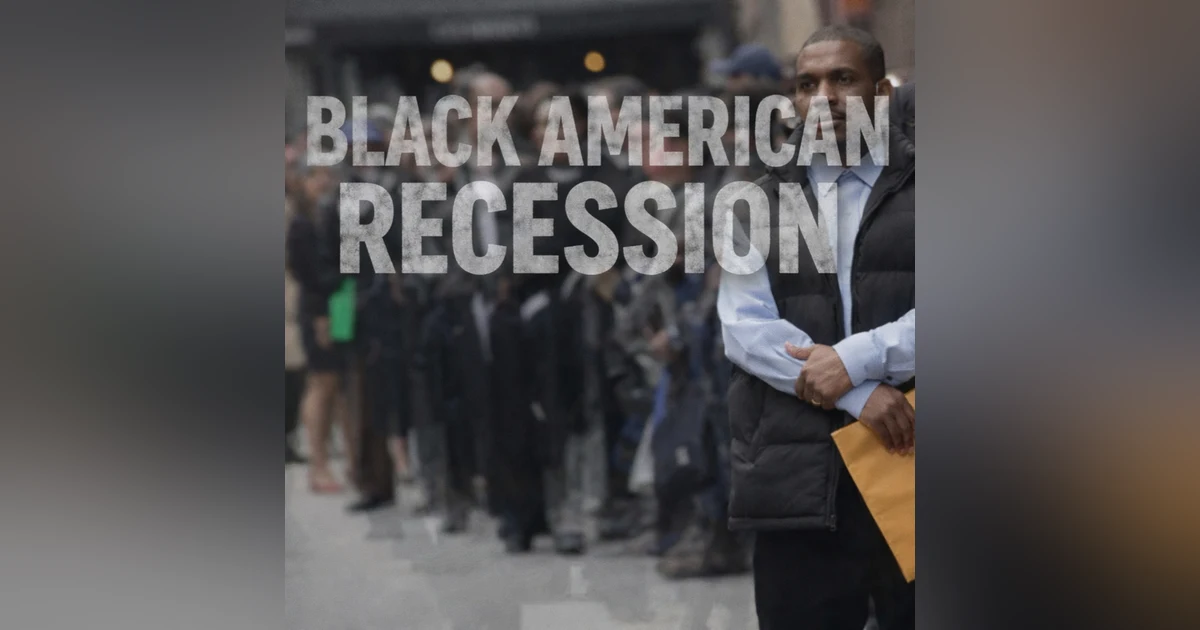
We laugh to keep from crying. If your bank account is a jump scare, this episode is for you. Black American communities are living in a recession inside a recovery inside a delusion.
Sources used in the making of this episode:
1. Tears.
2. Pain.
3. Fatigue.
4. "State of the Dream 2026: From Regression to Signs of a Black Recession" published at https://jointcenter.org/state-of-the-dream-2026-from-regression-to-signs-of-a-black-recession/
Follow the show at www.ayanaexplainsitall.com
Follow the host on TikTok @lawgurrl; IG/Threads @lawgurrl2
Join the conversation by leaving a comment for the show on our social media pages!
Ayana Fakhir (00:00.802)
You ever notice how the headlines saying that the economy is strong or that it's stable? Never say for who that is true. For whom that is true. Here's the truth. Black America is in a recession. Not heading toward, not at risk of, but in it.
and we can feel it everywhere. Black unemployment is high, black wealth is sliding back, black businesses are closing faster than they can get loans approved. But the official reports, silent, muted, acting like we're imagining it.
Ayana Fakhir (00:54.008)
This isn't a feeling though. This isn't our imagination. This is a curious, curious conclusion. This is intentional. This is policy doing what it was intended to do, sabotage Black America. This is history repeating itself with better graphics. This is what happens when the economy recovers, quote,
recovers, but skips black communities on the way. So today, I'm naming it. I'm mapping it. I'm dragging it out of the shadows and into the microphone. Because if the economists won't call it what it is, if the government, the federal government, the state, the local governments won't call it what it is, I will.
I've got some explaining to do. Let's get into it.
Ayana Fakhir (02:27.599)
Hey everyone, welcome back for another episode of Ayana Explains It All, the podcast bridging the gap between current events and human behavior. I am your black Muslim lady lawyer host coming to you recorded. I'm not live coming to you recorded. I always want to stay live for some reason. I ain't live. This is 10 17 PM on Saturday, April 25th. I am recording this in my little recording closet in Northeast Ohio.
Ayana explains it all is the podcast bridging the gap between current events and human behavior that is available on multiple streaming platforms, including YouTube, iHeartRadio, Apple Podcasts, Amazon Music, Good Pods, and a whole host of others, including our flagship Spotify. Please visit us, visit me, visit the podcast on one of those streaming platforms and many more.
You can also go to the show's website, www.ayanaexplainsitall.com and get all things podcast, every episode of the podcast actually, and all the transcripts when I remember to load them, and a blog when I remember to write it. But also show notes, ways to reach out to me, the host, if you want to be on the program, if you want me to be on your program, you can also do that. You can email me, you can rate the podcast.
And you can find out ways to support the podcast. Again, this is an independent indie podcast that I do all by myself. I've got all the equipment and all the brains and I'm just sitting here in a closet talking into a microphone. I love what I do. I love it. You guys also, you can, I should probably put this on the website too, link to the Our Vote Counts YouTube where I have moderated.
dozens and dozens of town halls with political candidates who have races in the upcoming midterms for 2026. Listen, it's been exciting. I've been working with our vote counts since last July and we have done, I want to say we've done nearly 200 of these. It's almost 200. We celebrated our 100th a couple months ago. We've just been tearing through these.
Ayana Fakhir (04:51.31)
Honestly, all the feedback we get from candidates is that, my gosh, this is wonderful, this is so needed. I absolutely needed this, you guys are doing a good job. The feedback we get from the public is this is so necessary, this is needed. Giving a voice to grassroots candidates, letting people know who's running for office, educating people about voting, because we don't just talk to people about their candidacy. We also educate voters. We have videos on our social medias that educate people on...
early voting, primary dates, how to vote in their state, who's got what election coming up. We also do little videos for the candidates so people, they wanted to, if they see someone's name on a primary ballot, you know how you can look up your ballot before you go into the polls, you can go and look at the little video that we made for the candidate on the ballot on their platform, what they're all about.
Look them up. Or you can go to our YouTube, Our Vote Counts YouTube, and you can look at their hour and a half long, sometimes, most of the time, town hall and find out what they're all about. You gotta know, you gotta know what these people are about. Because listen, there's some shady, shady, shady people in office. There's some people who I told you last episode, you give them your vote and they get...
to that door and they forget your name. They forget who got them there. They forget what what what what do you mean? I the people elected me. What do you mean? I have no idea. People what do you mean? So you got to know who you're voting for and all of the different races. There are some races in my in my district. I had no idea. No idea. And I researched them. I went to a couple of different sites to figure out what the heck this race was.
and found out some interesting things about the Democrat and Republican parties in my region of Northeast Ohio. That is where I am at, Northeast Ohio. Apparently you have to run for the seats, the chairs for the party. You have to run. That's an elected office, at least in the state of Ohio. They have an at-large member, a man.
Ayana Fakhir (07:16.515)
and a woman, male and female, at large members. But they also have, like, who are the executives? As you run for executive of the Democrat party, they do this for the Republican party, too. I'm like, what? I have never heard of this. I have never heard of this. This is interesting. I thought people just, you know, just join a party. I thought, you know, they had their little...
elections in their, in their, uh, and during their club meetings. I didn't know it was like an elected office. Wow. And so that's on the ballot too. That primary is on the ballot too. So many things, man. The primaries is where it starts. The primaries is where it starts, honey. Show up for the primaries. My primary is May 5th, 2026. And, uh, that's in 10 days. Wow. 10 days. Um,
I know who I'm going to vote for. I'm supposed to vote early. Y'all, I've been so busy. Oh my gosh. I have made, I made my plans. I looked at my ballot. I picked out all of my candidates, all of the races, and I haven't made it to early vote. I haven't. I have been so busy. I can't even believe this, but I'm a huge advocate for early voting. If I could get it in this week, please, dear God, inshallah, I can get it in this week. I would love to go with my daughter.
to vote with her for her very first time. She wants to vote in person her very first time. I would love to go with her to do that. But I don't know. Early voting just seems so much better because they can't pull any shenanigans when you early vote, you know? Although I've never had any shenanigans with my ballot before. early voting, you just never know what's going to happen. You never know what's going to happen. You wait until that day.
And then that day, you know, something really crazy, like an emergency appendectomy is required or something, or you oversleep, ooh. But it's a working day, so I won't be asleep. But in the state of Ohio, you're supposed to get four hours, four hours for voting, unless you're a specific type of employee, like a federal employee, you don't get that.
Ayana Fakhir (09:42.095)
Hmm
Yeah. So, listen, y'all, I have been trying to get to this topic for so many weeks now, so many freaking weeks, and I've been doing so much stuff. You know, I got a senior in high school. I got a kid in college already. I obviously have my full-time job, and I have these town halls that I've been doing several times a week, and...
I just haven't had the time. And you know what else I've been doing? I've been doing a lot of reading. You guys know that I love to read about the topics that I'm talking about. When they come into my head, I just, I have to read about it. Or sometimes reading is what puts the topic into my head. But this one, this one came from things I've been seeing on social media about the black unemployment rate. But also I've been on, I've been in them TikTok streets on TikTok live.
talking on a few live panels about this issue of the black recession. People are not calling it a recession. I'm calling it a recession because that's what this is. People are not calling it a recession. They're just saying, it's high unemployment and we're losing our wealth and you know, there are no jobs. Okay, sounds like a recession. We're losing our homes, we're losing our jobs, we're losing our wealth. Sounds like it might be a recession.
And I read a report, I read a report called The State of the Dream 2026 From Regression to Signs of a Recession by the...
Ayana Fakhir (11:32.537)
What is who's?
Ayana Fakhir (11:37.072)
by the Joint Center for Political and Economic Studies. This is from January 2026. So they called it back in January 2026, and it's now April. And I'm like, yes, yes, absolutely. Let me just read you a passage from this. It's called The State of the Dream 2026.
Ayana Fakhir (12:11.664)
And it covers topics such as employment and unemployment, federal unemployment, tax policy, entrepreneurship. It looks at broadband policies, social media policies, all of these different factors. They have studied to see how black people are doing under the Trump administration, the second Trump administration compared to how we were doing in say 2024, 2025, 2022, know, during the Biden administration.
And what they've discovered is not, it doesn't bode well. They said, and this number is still true, the black unemployment was 7.5 % in December of 2025. And it says a level that if seen nationwide would indicate a recession.
The December 2025 unemployment data for black youth continued a long pattern of high unemployment and strong fluctuations with a dramatic increase from 18.6 % in September to 29.8 % in November, then back to 18.3 % in December 2025. So even the babies, even the babies have it hard. Corresponding with the increase in black unemployment, it goes on to say,
has been an overall attack on structures and institutions historically aimed at addressing racial inequality. The Trump administration has overturned historic executive orders such as LBJ's 1965 Equal Employment Opportunity Executive Order and ended more contemporary department and agency-level programs designed to address racial inequality and advance diversity.
Ayana Fakhir (14:07.051)
One of the, if then it goes on to say, one of the strongest victories of the mid-20th century, Black Freedom Movement was making the federal government a leader in inclusive employment for African Americans and in monitoring for discrimination. About 60 years later, instead of aggressive leadership in dismantling structures of racial inequality, we are witnessing regressive leadership.
that is slashing government employment and agencies designed to address predatory economic practices that are likely to disproportionately harm black communities. The one big, beautiful bill, ACT, also entrenched permanent tax cuts for high-income and high-wealth households and corporations, reduced investment in property alleviating programs, and left support
for working families stagnant or diminished. The systematic withdrawal of protections, investments, and accountability mechanisms that have historically assisted black communities from economic shocks combined with a substantive increase in black unemployment all point to 2025 as a regression and recession for African Americans. So when I refer to the black American economy,
I'm not talking about a separate formal economy like a country's GDP. I'm talking about the economic activity, the financial position and collective market power of Black Americans within the United States economy. How money is earned, spent, saved, invested and circulated within that population. We look at the size and purchasing power. We look at income versus wealth.
We look at labor and employment patterns, business and entrepreneurship, spending patterns, and circulation. We also look at structural constraints. Why it's discussed as a separate economy is to highlight internal economic dynamics, measure group-level inequality, argue for targeted policy or investment, and examine whether Black Americans function as a labor force, a consumer class,
Ayana Fakhir (16:31.084)
or a self-sustaining economic block. Right now, the evidence points to stronger consumer power, but limited control over production, capital, and infrastructure. The Black American economy in some is best understood as a large and influential consumer economy embedded within the United States.
but constrained by historical and structural barriers to wealth accumulation, ownership, and capital access.
Ayana Fakhir (17:09.2)
Median black, for instance. The estimated buying power of black Americans is 1.6 trillion to 1.8 trillion annually.
For instance, the estimated buying power of Black Americans is somewhere in the trillions of dollars. If it were a standalone country, the amount of spending power in the Black economy would rank among the top economies globally. But that number, that trillions and trillions, be that, but that figure can be misleading without context. It reflects spending power, not wealth or economic security.
So let's look at income versus wealth. So let's look at income versus wealth. This is where the real structure shows up. The median black household income is significantly lower than white households. And the median black household wealth is roughly 10 to 15 % of white household wealth. And this gap is tied to historical exclusion from slavery, Jim Crow, and redlining.
but also labor market segmentation and unequal access to capital and home ownership. So the black American economy is consumption heavy, but asset light. And by 2024, the black American economy had started to close the gap between whites and blacks when it comes to amassing wealth. But since 2025, we have been regressing.
And as far as labor and employment patterns are concerned, Black Americans are overrepresented in public sector jobs, but underrepresented in high capital, high ownership sectors such as tech ownership, finance, such as tech ownership, finance, and large scale manufacturing. This matters because jobs generate income, obviously, and ownership, however, generates wealth and control.
Ayana Fakhir (19:19.524)
But public sector jobs, as I stated, have provided stability and growth in the black community, have provided stability and powerful economic growth in the black community. Black-owned businesses make up a small share of total U.S. businesses, but they are disproportionately smaller in scale, underfunded, and concentrated in service industries.
They also have a limited access to capital and credit.
A major structural issue often discussed about the black economy, about the black American economy is spending patterns in circulation. Black consumer dollars tend to leave black communities quickly. And we have lower rates of business ownership, as previously stated, banking access historically and institutional control. This leads to weaker economic circulation, sometimes called
the dollar staying power problem.
Ayana Fakhir (20:30.234)
The Black American economy is also shaped by systemic forces, not just individual behavior. For instance, housing policy, the redlining legacy is included in that, education funding disparities, criminal justice impacts on employment, and credit and lending discrimination. And these aren't abstract. They directly affect where people live, what jobs they can access, and whether they can build wealth.
and whether they can build wealth.
Ayana Fakhir (21:16.826)
So what impact has recent legislation had on the black American economy? And by recent legislation, I am speaking of the big, beautiful bill that was passed in July of 2025. Now, some will argue that these cuts that everyone's talking about coming from the big, beautiful bill are just fear-mongering.
their exaggerations or they are imaginary.
But a lot of spending that happens when it comes to social welfare programs or public, when it comes to social welfare programs or education programs depends on how much of the money gathered from the federal government the state gives to a particular program. So the federal government gives money, gives block grants to the states for Medicaid, for Medicare.
for education, for environmental projects, for justice system projects, law enforcement, et cetera, et cetera. And the states decide how the money will be spent. They give it to local governments, and then local governments decide how the money that they receive from the state will be spent. The state sometimes doesn't give them all of the money that they're entitled to.
And then when the local governments receive the money, they sometimes don't spend it all on its intended target. And I'm not talking about wasteful spending. I'm talking about willful withholding of funds, willful withholding of funds, and also misappropriation of funds. So I'm not talking about, doge and they need to be, they need to make cuts and they need to go fraud and it's so many different factors that go into why
Ayana Fakhir (23:13.552)
programs do not receive the amount of money they're entitled to, but also why recipients are sometimes cut from these programs. It's not often, it's not always the case that a person has too many income and resources for something such as Medicaid or Medicare or disability or unemployment or et cetera, et cetera, or SNAP or TANF.
Sometimes it's that the program does not have enough money to give to all of the people who need assistance. So they change the requirements. They change the income requirements. You may have qualified six months ago, but now you don't because the state did not receive as much money as they thought they were going to receive or they don't have enough in their budget to support the number of people they could six months before. So when the big beautiful bill comes in and says, okay,
You're only going to get $60 billion for this. Here you guys go. Spend it as you see fit. Well, the state gets to decide who qualifies for Medicaid, and they do that based on how much money they receive. So if they're only getting, I don't know, $10 billion, and maybe that could cover 500,000 people in 2024, well, now that can only...
Maybe they they asked for 50 billion and now they're receiving 10 billion and they could and I'm making these numbers up because I have no idea Ohio is changing Ohio in response to the big beautiful bill actually is changing the number of recipients It will cover under Medicaid. So when people talk about cuts, they're actually talking about people being cut from the rolls the requirements will change
The number of people eligible will change because the amount of money has changed. But also services covered will change. The government will no longer cover certain medications. They won't cover certain procedures. They won't allow you to see certain doctors or specialists. So yes, cuts will have to be made because the amount of money going to these programs has shifted. And by shifted, I mean decreased. Recessions of the past.
Ayana Fakhir (25:39.12)
come out of oppression in labor. Because this isn't the first time labor has been exploited in the history of the United States. This isn't the first time that corporations have exploited people in the United States. But the one way they were able to get out of it is by working together, is by communities coming together to fight the culprit, the main culprit. We, each other,
The working class people, we are not the culprits.
Right? We keep reducing this to, it's their fault. It's the Latinos' fault. They come here and they take our jobs. It's the Haitians' fault. It's the Jamaicans' fault. It's the Somalians' fault. They come here and they take our jobs. And frankly, that's lazy. Again, if you follow the thread all the way back, you don't land in our communities. You land in systems. You land in policies. You land in decisions that were made
long before many of us were even born. This country built its hierarchy on race and class.
deliberately, strategically, and over generations. You don't get centuries of inequality by accident. You get there through design. What is happening to the black community is by design.
Ayana Fakhir (27:11.8)
And how we got here was through slavery segregation, through policies like redlining that decided who could live where, who could build wealth, and who would be locked out. And so every time the presidency changes, our bite at the apple, our ability to bite at the apple changes. Our growth, our wealth growth changes. Either the gap widens for blacks and whites
or it closes. And it was closing. The gap was closing. Blacks were building more wealth. We were closing the gap. It was still a gap in 2024. But in 2024, Black Americans showed an increase in wealth. And now, now, we are regressing. We are regressing. Not through, not because we're doing anything wrong.
not because we're being lazy or not being intentional about growing our wealth, it's because we're losing money. We're losing jobs, we're losing money, we're losing our homes, we're losing our savings, we can't invest.
Ayana Fakhir (28:31.364)
This is what is happening. We're not able to put anything into the economy.
They can't pay for school, higher education.
This is what's happening.
Ayana Fakhir (28:46.82)
And then after all of this separation, inequality, inequities, after all of that.
You know, the government takes these different groups of people and then after all of that...
The government forces black Americans to fight with other immigrant groups. And after all of that, all of that systemic racism and inequality and inequities, the government forces black Americans to fight immigrant groups.
for stability. We're fighting other groups for stability. We're being pitted against each other.
Ayana Fakhir (29:31.908)
That's not an accident. You're in arguments daily, weekly, politically with people whose economic position is almost identical to yours, right? Same debt pressure, same housing stress, same fragile job security, and yet you're treating each other like enemies. Why?
because if two groups of workers are busy fighting each other, they are not organizing. They are not negotiating. They are not building leverage. are not, they are neutralized. That's not an accident. It's not an accident that black Americans are being pitted against Latino Americans, especially in a fight for resources. And then being told that resources are scarce. And then one group is said to look at the other.
Ayana Fakhir (31:12.656)
that's why. The obvious question should be who made those decisions? Who outsourced the jobs? Who suppressed the wages? Who weakened labor protections? But that's not usually where the conversation goes. Instead, it goes to those people there taking our jobs. Those people are the reason they're undercutting wages. Those people are draining our resources. And I hear this all the time.
on these TikTok lives. Nobody wants to talk about policy and power. They want to shift the conversation to people and identity. They've obviously been manipulated to think people and identity are the reason why the black unemployment rate is so high. They're the reason why you can't find a house. They're the reason why there's a high crime.
Right? It's insane. And it's not new. It's not new. This pattern shows up over and over in American history. In the 1800s, white workers were told Chinese laborers were the problem during railroad expansion that culminates in the Chinese Exclusion Act.
Ayana Fakhir (32:32.356)
That culminates in the Chinese Exclusion Act, one of the first major laws to explicitly block a group based on ethnicity.
In the early 20th century, black workers were often used as strikebreakers, not because they were the cause of labor conflict, but because employers exploited segregation to fracture solidarity. And you fast forward to today, and the script hasn't changed much. It's just been modernized. And sometimes the group changes, too. Haitians, Jamaicans, Somalians.
any kind of African, really, or even Indians. And it's just suddenly we're looking at people going, you're the reason why I don't have health care. You're the reason why I can't get food stamps. Everybody's getting food stamps but me. Everyone's getting health care but me. We've been pushed into this scarcity mindset and then told that some other group of people is the reason why we can't have
the thing that we think we're entitled to.
but also something else is happening. Unions are declining. The Trump administration is trying to weaken unions. Collective bargaining power is weakened in the federal government. It's being weakened elsewhere, too.
Ayana Fakhir (34:01.858)
And at their strongest, labor movements forced people who didn't like each other to still fight for the same contract. And without that structure, division fills the vacuum.
Ayana Fakhir (34:16.915)
For many politicians, it's far easier to mobilize voters through identity-based grievances than through detailed economic reform. Blame is cheap. Structural change is hard, obviously, because they don't do it. Easy to blame, easy to hand out blame. Much harder to build people up. It's much harder to build structures that aid people, that keep communities together, right?
Ayana Fakhir (35:15.09)
But what we're faced with, the black recession, is not going to be won by blaming immigrant groups. It's not going to be overcome by blaming immigrant groups. It's not going to be overcome by blaming Latinos. It's not going to be overcome by blaming undocumented workers. It's not going to be overcome by deporting anybody. It's not going to be overcome.
By deporting groups of people, it's not going to be overcome by blaming other groups of people based on their identity or country of origin. Again, if you trace the thread all the way back, it doesn't come back to our communities, does it? It comes back to the systems, to the corporations, to the government. So how has the big beautiful bill, or how will the big beautiful bill now law? I don't even know the name of this law.
Does anybody know the name of this law? I still call it the big beautiful bill or the big ugly bill. The big ugly massive cancerous tumor of a bill rather.
It's a sweeping tax and spending package, we know that, that extended and expanded earlier tax cuts from the Tax Act. The Tax Act, the Tax and Jobs Act, that's a mouthful. It cuts over $1 trillion from programs like Medicaid and SNAP. It adds new work requirements and eligibility rules to these programs.
and it shifts benefits towards higher income households and businesses. The real question that I pose is how does this hit the black economy? Well, safety net cuts, for instance, lead to a direct hit to our economic stability. With these major cuts to Medicaid and SNAP and new work requirements, there would also be
Ayana Fakhir (37:21.626)
more frequent eligibility checks, reduced benefits and stricter access to these benefits, more rules, more rules so that they can have fewer people on these programs because the aim is to not have these programs at all. At some point, the Republican Party would love for the government, the federal government, to shift its focus from providing for its citizenry
to everyone work and pull themselves up by their bootstraps. And it's not just the federal government. It is also state and local governments, too. They'd rather not provide adequate healthcare coverage, food assistance, cash assistance to its citizenry. They'd rather keep that money in their pockets. I know it sounds harsh, but it's the truth. It's the truth.
And these programs that are being cut obviously disproportionately support lower income households. And Black Americans are overrepresented in those income brackets.
And that's a structural reality, not a preference. And the consequence is less access to healthcare and food assistance, more income volatility, and higher risk of debt, eviction, and financial instability. There's also a macro effect.
Ayana Fakhir (38:58.108)
There's a projected 1.2 million job losses that will be tied to these cuts due to reduced spending in local economies. So yeah, think about that. Snap benefits are cut. So you're not spending as much on food, right?
You're not spending in your local economy as much. And if you have to spend more money on healthcare, on doctors visits and medication, you're not spending as much, you know, you're not going to the mall, you're not buying a car, you're not buying a new house maybe. You're going into debt. You probably have to declare bankruptcy. You probably have to file for bankruptcy protection. Also, there are tax changes.
With benefits that are skewed upward, there are new deductions, obviously. There are permanent lower tax rates from the 2017 policy. There are new deductions, which we have heard are not permanent. They will expire, such as no tax on tips, no tax on overtime.
and it expanded business tax breaks. So tax cuts obviously help the most when you have higher income investments and business ownership. And so the consequence from the big, beautiful cancerous tumor act is higher income households gain more wealth and lower income households see smaller or temporary gains.
Ayana Fakhir (40:44.53)
Multiple analyses of these tax changes conclude that this law redistributes income upward. And since Black households have lower median wealth, this widens the gap even if everyone technically gets a tax cut.
Ayana Fakhir (41:07.1)
So Medicaid and SNAP are tied to work requirements. They have been for some time, since the Clinton years.
The claimed goal is to increase labor participation. Fine. People have to work for 20 hours a week to maintain SNAP. They have to work 20 hours a week to maintain Medicaid. If you're disabled, you don't have to do that.
Okay. They also added a new crop of people to that work requirement. So if you had aged out of foster care, you didn't have to do that. You didn't have to have the work requirements. Now you have to. If you were a veteran, you didn't have to. Now you have to.
And many people already work, but they work in unstable jobs. They do a lot of gig work and formal jobs. And caregiving roles are now no longer counted as work. So you can't be caring for an elderly relative and call that a job and have that job count towards the hours you have to spend in order to maintain SNAP or Medicaid.
So again, we're looking at a loss of benefits without stable job replacement. This does not result in upward mobility, obviously, and it doesn't build a stronger black economy. It raises the floor of survival without raising the ceiling of opportunity.
Ayana Fakhir (42:47.196)
There's also student debt and education changes.
There have been cuts and restructuring of student loan programs, student loan support programs. There have been cuts to or restructuring of student loan support programs. There has been reduced federal support for education systems thanks to this big cancerous act. I keep changing the name. And why does this matter? Because black student loan borrowers
carry disproportionately high student loan debt.
And now thanks to slower wealth accumulation or job loss, we're going to see delayed home ownership in the black community. We're going to see reduced entrepreneurship capacity in the black community.
Ayana Fakhir (43:46.394)
And while the Act increased small business tax deductions...
Ayana Fakhir (43:54.246)
and that helps business owners, black business ownership rates are lower.
and access to capital remains a barrier. So while the benefit exists for small business owners, for entrepreneurs, it is not broadly distributed within the black community.
And the structural bottom line across independent analyses shows that the cuts hit low income households the worst and the most. The gains flow to higher income households and capital owners, which all leads to greater inequality over time. And that inequality will come to bear for the Black community first and worst.
Ayana Fakhir (44:48.402)
The Black American economy is heavily reliant on wages and public sector jobs and consumption, and less anchored in capital ownership and wealth.
That makes the effects of this bill particularly devastating for the black economy because it reduces support at the bottom with the social safety nets and increases advantages at the top with tax policy changes and capital changes. With tax policy changes and access to capital still being a barrier for black entrepreneurs.
So the likely outcome of this big cancerous act.
is that there will be more financial strain in the black community with limited pathways to wealth building.
So you take all of those changes and you combine them with what is happening with black unemployment numbers being at 7.3%.
Ayana Fakhir (46:02.63)
We're looking at substantial economic losses, generational losses.
without any safety net, without any relief in sight. And that if we don't do something about this right now,
We will not recover as black Americans from what is happening for anywhere from 20 to 40 to 50 years.
Ayana Fakhir (47:08.21)
Big Beautiful Bill Act, whatever you call it, does not build a stronger, self-sustaining black economy. It largely reallocates resources in ways that make existing inequalities more pronounced. We are once again in the black American community looking at mounting inequalities. We have not seen this since the 1970s.
Ayana Fakhir (47:37.38)
And we're facing these without a lot of the protections that we had in the 1970s.
Ayana Fakhir (47:57.81)
So let's stop playing games with branding. There's nothing beautiful about a law that pulls resources out of the bottom of the economy and hands structural advantage to the top, then pretends everyone benefits equally.
Ayana Fakhir (48:33.52)
In a country where inequality is already baked into the foundation, race-neutral policy with unequal starting points produces unequal outcomes every time. It cuts the floor out from under people who are already standing on unstable ground. When you slash Medicaid and SNAP, you're not trimming waste. You're removing healthcare, food stability, and economic shock.
and economic shock absorbers from millions of people. And because Black Americans are disproportionately represented among lower-income households, which, by the way, is not by accident, but by design of history, those cuts land harder, faster, and deeper. And here's the part that people perhaps don't want to say out loud because it makes them uncomfortable. The Black American economy is not fragile because people don't work
It's fragile because it is overexposed to wage income and underexposed to ownership. So when a law reduces safety nets, fails to expand ownership pathways, and rewards capital more than labor, it doesn't just miss Black Americans. It systematically squeezes them. Now let's look at the tax side. Yes, there are cuts.
Yes, some people will see slightly bigger paychecks, but tax cuts are not neutral tools. They scale with what you already have. If you own assets, businesses, or large incomes, then tax cuts compound wealth. But if you're living paycheck to paycheck, they barely move your long-term trajectory. So what's really happening? We are watching a policy that amplifies capital and calls it growth
while weakening the very systems that keep working class people economically stable. And then we act surprised when inequality widens. Work requirements? Yeah, they've been around for a while. Let's talk about it. The narrative says this will push people into the workforce if we require them to work for SNAP and work for Medicaid.
Ayana Fakhir (50:58.3)
But that assumes that people aren't already working, and they are. Sometimes two jobs. They are working, they're hustling, they're caregiving, or surviving in unstable labor conditions that don't fit neatly into bureaucratic definitions of employment. and by the way, caregiving now is no longer considered employment for SNAP and Medicaid. You can't be giving care, you can't be...
providing caregiving to an elderly relative and making an income and calling that the work that you do to maintain your benefits.
Ayana Fakhir (51:40.39)
So what is happening when we require people to work to maintain food assistance and health care and health insurance and health insurance subsidies? People lose benefits faster than they gain stable income. That's not mobility.
That's not mobility, that's a grinding. And grinding is expensive, financially, mentally, generationally. Now step back and look at the full picture. The black economy in America is driven by consumption without control. The money comes in and it goes right back out into rent, food, healthcare, transportation, often to systems not owned by the community spending the money.
So when you reduce incoming support and increase financial pressure, and you fail to build ownership infrastructure, you don't just slow the economy, you drain it. It reinforces a structure where Black Americans remain a labor pool and a consumer base, but not a capital class. And without capital, there is no leverage.
And this isn't about one party or one bill. This is about a pattern in the United States. Policies that ignore structural inequality don't produce neutrality. They reproduce hierarchy. And we know that the United States is a class hierarchy and is a race hierarchy that comes to bear for everyone except the white, wealthy class at the very tippy top.
Ayana Fakhir (53:44.144)
It stabilizes the top. The top still remains at the top. It just puts more pressure on the bottom. And then it calls that a balance. It calls that a win. Remember the pictures, the videos of the Republicans celebrating as Donald Trump signed that bill into law.
Ayana Fakhir (54:05.478)
That's not balance. That's not balance. And until policy starts addressing ownership, capital access, and structural barriers directly, every big bill, no matter how it's branded, will keep delivering the same result. A stronger economy on paper and a weaker position for the people carrying the most weight. And that is, right now, Black Americans.
because of the recession created by the Trump administration in our economy.
Black America is in a recession.
Ayana Fakhir (54:53.412)
And if we don't say the thing, name the thing, we cannot fix it.
Ayana Fakhir (57:26.994)
to when you ask, are black Americans in a recession?
When people say no, you tell them that that's not true.
We absolutely are. There are two economies in America, and one of them is breaking.
Ayana Fakhir (57:51.427)
One of them is breaking.
Black unemployment has been hovering around twice the rate of white unemployment. Not slightly higher, but double. Now ask yourself something real. If the national unemployment rate suddenly jumped to seven or eight percent, what would we call that? We wouldn't call that resilient. We wouldn't call that cooling. We'd call it a recession.
But when that same level of pain is concentrated in black communities, it gets renamed, rebranded, softened. It's called a disparity, a lag, a challenge.
Ayana Fakhir (58:38.586)
And it's none of those things. It's a contraction. It's loss. It's instability. It's a recession. If these numbers, these unemployment numbers showed up across the entire population, no economist would hesitate to call it a recession. And even though you're not supposed to call it that, you need to call it that. But it's not just about jobs. It's about home ownership. It's about public sector jobs. It's about black-owned businesses.
It's about tax policy. It's about employment policy. It's about illegal firings, stagnating assets, the eroding stability. That's the definition of a recession. And it's not evenly distributed, but it is coming for every single one of us.
Ayana Fakhir (59:33.98)
And this has been Ayana Explains It All brought to you by Facts, Figures, and Enlightenment. Take care.